Crochet Abbreviations Glossary: US & UK Terms
The same words mean different stitches in each system — here's every common abbreviation, side by side.
In my classes, the mistake I see most often isn't a stitch gone wrong — it's a crocheter reading one little abbreviation as if it meant the same thing everywhere. I've had a student arrive with a half-finished blanket, convinced her tension was broken, when every row had simply been worked in UK double crochet while she was following US instructions. We sat with a cup of tea and this glossary, matching each term side by side, and she finished the thing correctly over one weekend. That afternoon is why I keep this page as its own reference rather than a footnote: knowing whether "dc" means double crochet or treble, and "sc" means single crochet or double, saves you hours of quiet frustration before you even pick up your hook.
US vs UK terms, side by side
| US term | US abbr. | UK term | UK abbr. |
|---|---|---|---|
| Slip stitch | sl st | Slip stitch | sl st |
| Single crochet | sc | Double crochet | dc |
| Half double crochet | hdc | Half treble crochet | htr |
| Double crochet | dc | Treble crochet | tr |
| Treble crochet | tr | Double treble crochet | dtr |
| Double treble crochet | dtr | Triple treble crochet | trtr |
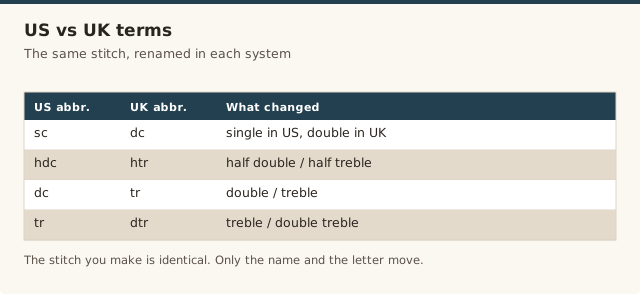
Notice that the abbreviation dc appears in both columns for different stitches — this single overlap is the source of most terminology mix-ups.
The fastest tell: if a pattern uses sc, it's written in US terms, because there is no sc anywhere in UK terminology. The same works in reverse — a pattern using htr is UK, since htr (half treble) doesn't exist in US patterns.
Abbreviations that only exist in one system
A few common abbreviations look identical in both systems but aren't, because they inherit their meaning from a stitch name that changes. These are the ones worth checking before you assume a pattern is consistent.
| Abbreviation | US meaning | UK meaning |
|---|---|---|
| ss | Not standard; US patterns use sl st | Slip stitch |
| dc2tog | Double crochet 2 together (a decrease) | Treble crochet 2 together, usually written tr2tog |
| tr2tog | Treble crochet 2 together (a decrease) | Double treble 2 together, usually written dtr2tog |
Because each of these inherits from a stitch name that shifts between systems, the safest habit is to identify the base stitch first using the table above, then apply the 2tog or tog part.
Counting loops on the hook
Once a pattern tells you to yarn over and pull up a loop, the number of loops sitting on your hook is what tells you when the stitch is finished. Working yarn over again draws a new loop through, so the count drops by one each time. Three loops on the hook after pulling up a loop means you've reached the yarn-over stage of a double crochet; two loops means you're at the final pull-through of a single crochet. If your loop count doesn't match what the step describes, stop and recount rather than pulling through anyway — that's how a single crochet quietly turns into something that isn't one.
Other common abbreviations (same in both systems)
| Abbreviation | Means |
|---|---|
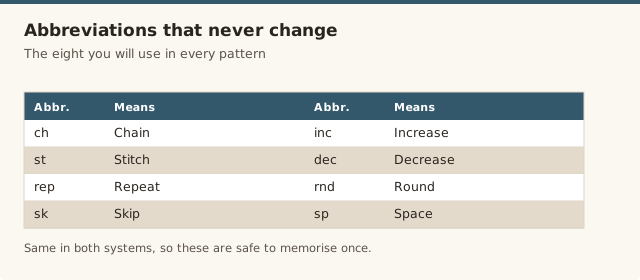
| ch | Chain |
| st(s) | Stitch(es) |
| rep | Repeat |
| sk | Skip |
| sp | Space |
| inc | Increase |
| dec | Decrease |
| rnd(s) | Round(s) |
| yo | Yarn over |
| tog | Together |
| blo | Back loop only |
| flo | Front loop only |
| beg | Beginning |
| cont | Continue |
| rem | Remove |
| BO | Bind off |
| FO | Fasten off |
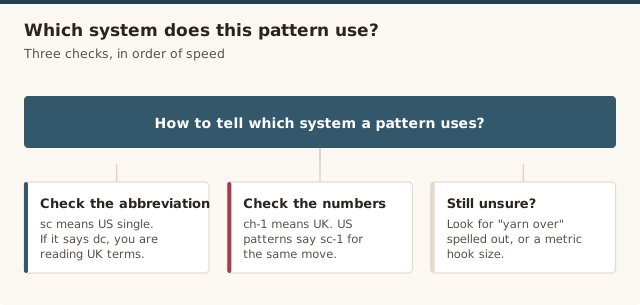
How to tell which system a pattern uses
Most published patterns state this near the top, often as "US terms" or "UK terms" in the materials list. If it isn't stated, the fastest check is looking for a dc stitch and seeing how tall it's described as — a short, dense stitch means US terms, while a taller stitch means UK terms. If you're still getting comfortable with the stitches themselves, our guide to the six basic stitches covers each one step by step.
If you're still getting comfortable reading a pattern generally, our guide to reading a crochet pattern covers abbreviations, gauge, and repeats from the start. If you're buying a pattern or ebook, our digital pattern guide covers what to check before you pay.
Reading pattern notation beyond single stitches
Abbreviations tell you what each stitch is, but patterns also use symbols to compress repeated sequences instead of writing them out longhand. An asterisk (*) marks the start of a repeat, closed later with "rep from * around" or "rep from * to end" — everything between the asterisk and that instruction repeats as many times as the pattern needs. Square brackets group a short sequence with a repeat count right after them, like [sc 2, inc] x6, meaning "work single crochet 2, then an increase, and do that whole group six times."
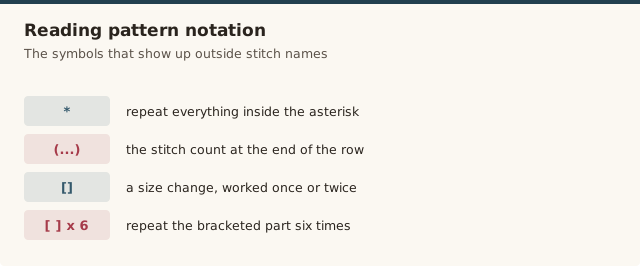
A number in parentheses at the end of a row or round, like (24 sts), is your stitch-count checkpoint — not an instruction to follow, but a total to check your own count against before moving to the next row.
Common mistakes & fixes
Fix: check the pattern's stated terminology before starting, and if it's not stated, compare the described stitch height against the abbreviation — a short dc is US terms, a tall one is UK.
Fix: read the full bracket plus its repeat count before starting the round, not stitch by stitch, and check your total against the stitch count in parentheses at the end of the row to catch a miscount immediately.
Fix: most standard abbreviations are consistent within one terminology system, but some designers invent shorthand for unusual or decorative stitches. Always check a pattern's own abbreviations key at the top before assuming.
Frequently asked questions
What is the difference between US and UK crochet terms?
The two systems use the same words for different stitches, offset by one. What the US calls single crochet (sc), the UK calls double crochet (dc). Checking which system a pattern uses before starting prevents your stitch count and fabric height from being wrong throughout the entire project.
How do I know if a pattern is written in US or UK terms?
Most patterns state it near the top, often as "US terms" or "UK terms." If it isn't stated, check the designer's country or the source website, and look for a stitch called "dc" used for a small, tight stitch (UK) versus a taller one (US).
Do stitch abbreviations mean the same thing in every pattern?
Within one terminology system, yes, standard abbreviations like ch, sc, and dc are consistent. Some designers invent their own shorthand for unusual stitches, so always check a pattern's own abbreviations key if one is provided.
What do asterisks and brackets mean in a crochet pattern?
They mark a repeating sequence rather than a stitch. An asterisk pairs with "rep from *" to mark where a repeat starts, and square brackets group a sequence with a repeat count after them, like [sc 2, inc] x6, meaning that whole bracketed sequence six times.
What does the number in parentheses at the end of a row mean?
It's the total stitch count you should have once that row or round is complete, used to check your work before moving on. If your count doesn't match, it's worth recounting that row before continuing rather than assuming it will even out later.
How do I convert a UK crochet pattern to US terms?
Shift every abbreviation up or down by one stitch. A UK double crochet (dc) becomes a US single crochet (sc), a UK treble (tr) becomes a US double crochet (dc), and a UK half treble (htr) becomes a US half double crochet (hdc). Work through the pattern line by line, then check your stitch count at the end of the first few rows to make sure the conversion is holding.
What does sp or spc mean in a crochet pattern?
It's shorthand for space, meaning the gap between stitches, usually a chain space created in a previous row, like the ch-2 or ch-3 corner spaces in a granny square. A pattern that says dc in next sp is telling you to work into that open gap rather than into a stitch.
CrochetGuides is a participant in the Amazon Services LLC Associates Program. As an Amazon Associate we earn from qualifying purchases, at no extra cost to you.