Left-Handed Crochet: A Complete Guide for Beginners
Everything is the same as right-handed crochet, mirrored — here's how to make the flip feel natural.
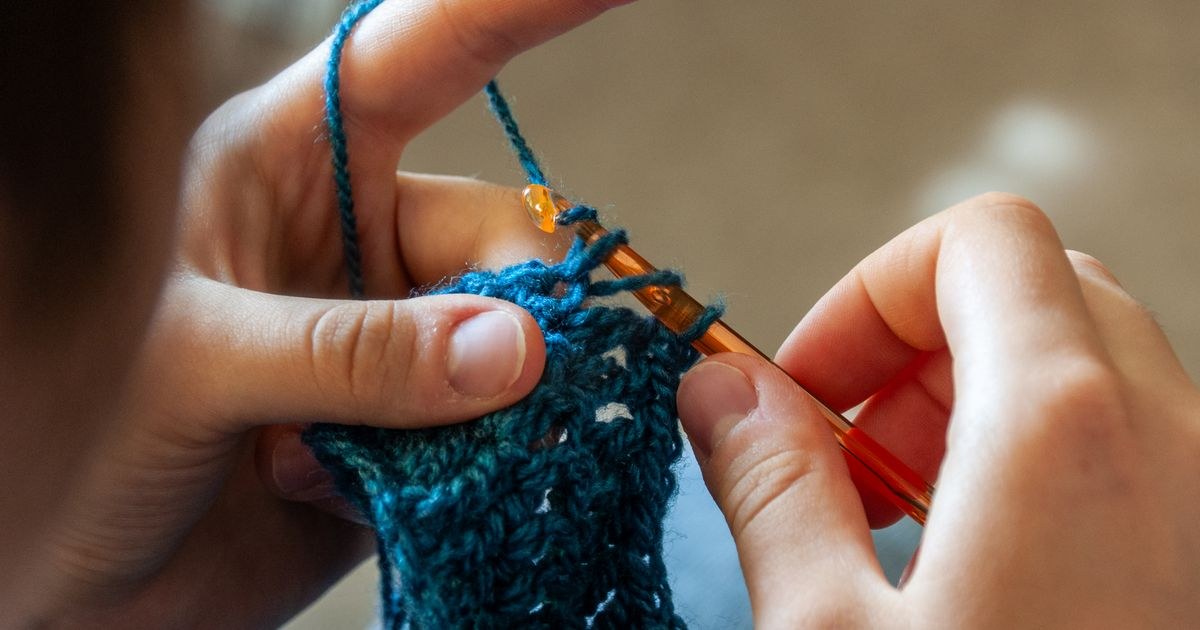
In my first few years of teaching, I'd hand a left-handed student a right-handed diagram and watch them frown at their own hands as if they'd done something wrong. Nothing was wrong — their hands were simply mirroring mine, and once I learned to explain crochet as a mirror image rather than a fixed left-to-right path, those same students caught up to everyone else within a single class. I'm Nora Fenwick, and I've taught crochet for twelve years, with roughly one in ten of my students being left-handed. This guide is everything I tell them: how to hold the hook, how to mirror a pattern, why charts are secretly your best friend, and how to survive the many video tutorials filmed for right hands.
Mirroring a right-handed pattern
Here is the single idea that makes left-handed crochet easy: everything you do is a mirror image of a right-handed crocheter. When I crochet right-handed, my hook travels from right to left across the row, and my completed stitches trail off to my right. When you crochet left-handed, your hook travels from left to right, and your stitches trail off to your left. If you held my finished work up to a mirror, it would look exactly like yours. Nothing about the stitch itself changes — a single crochet is built from the same two loops regardless of which hand holds the hook. Only the direction of travel flips.
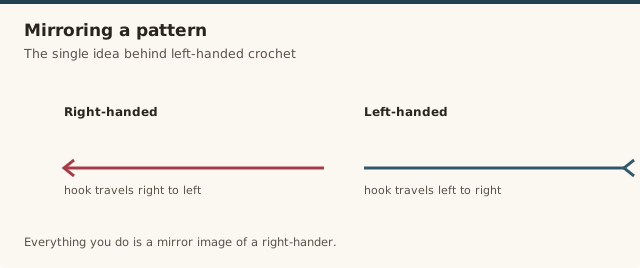
That distinction matters, because most left-handed frustration comes from trying to copy a right-handed person's hand positions exactly, rather than mirroring them. I had a student named Priya who spent three weeks convinced she could not make a chain. It turned out she was holding the hook in her right hand to match my photos, because she assumed she was "supposed to" — and the moment I told her to swap hands and stop copying, her chain appeared within ten minutes. You are not supposed to look identical to a right-handed photo. You are supposed to look like its reflection.
The practical rule is surprisingly simple: written instructions need no rewriting at all. "Insert the hook, yarn over, pull up a loop" is direction-free, so you follow it word for word in your natural left-to-right direction. The only time mirroring demands conscious thought is when a pattern shows you a photo or a diagram with a clear direction baked in — which side the yarn comes from, which way a cable or a slant leans. Flip that in your head, and work from the opposite side.
For most beginner projects this is a non-issue, because a scarf, a dishcloth, or a granny square is essentially symmetrical. Work it mirrored and the finished piece comes out looking identical to the pattern photo. The mirroring only becomes visible on asymmetrical shaping — a cardigan front, a diagonal stripe, a lace motif that leans one way. On those, your result will be the reverse of the photo, and that is correct, not wrong. If you'd like the shaping to lean the same way as the picture, you can deliberately flip the pattern's increases and decreases to their opposite corners, but honestly, most of us just make it mirrored and call it a design choice.
Holding the hook left-handed
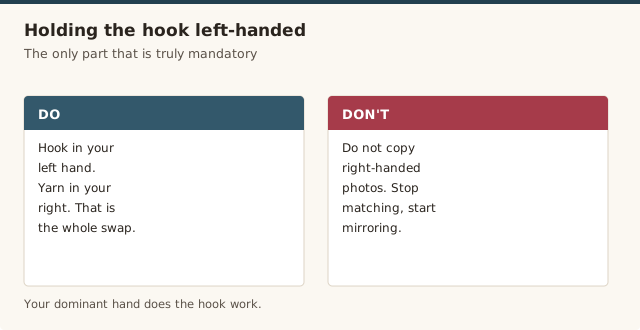
Hook in your left hand, yarn in your right. That's the whole swap, and it's the only part of left-handed crochet that is truly mandatory. Your left hand — your dominant hand — does the hook work, which is why left-handed crochet usually feels far less awkward once you let yourself do it. The right hand does the yarn work, and this is where I want you to be patient, because tensioning yarn with your non-dominant hand is exactly the challenge right-handed beginners have with their left hand.
Hold the hook like a pencil, or like a knife if that's more comfortable; the grip itself is identical to the right-handed version, just mirrored. Keep it loose in the crook between your thumb and index finger rather than fisted — a white-knuckle grip is the single most common cause of stitches too tight to work into on the next row, and it has nothing to do with which hand you favour.
For the yarn, most of my left-handed students settle on this hold: let the working yarn run over your right index finger, under your middle finger, over your ring finger, and give it one loose wrap around your pinky. Your right index finger then does the actual "yarn over" motion, lifting the yarn over the hook as you work. It will feel clumsy for the first few sessions because it's your non-dominant hand, but tension is a habit, not a talent, and it firms up surprisingly fast with daily practice.
One thing I tell every left-handed beginner: your yarn hand does not need to be clever. It just needs to be steady. All of the precision lives in the hook hand, which for you is the good hand. That's a quiet advantage left-handers have — your dominant hand is the one doing the fine, controlled part of the stitch. Keep that in mind on the days your right hand feels like it belongs to someone else.
Left-handed basic stitches
The four stitches below are the ones from our basic crochet stitches guide, written here with the left-handed direction spelled out. If you already know them right-handed, you'll notice the wording is almost unchanged — that's the point. The stitch is the same; you simply build it moving left to right.
Chain stitch
Abbreviation: chWith the hook in your left hand and the yarn in your right, yarn over (bring the yarn over the top of the hook with your right index finger) and pull it through the loop already on your hook. Repeat, and your chain will grow to the left of your hook. This is usually the very first row you make.
Slip stitch
Abbreviation: sl stInsert your hook into the stitch to the left of your current position, yarn over, and pull the yarn through both the stitch and the loop on your hook in one motion. Slip stitches add no height; they're used to join rounds or move across a row without building fabric.
Single crochet
Abbreviation: scInsert your hook into a stitch, yarn over and pull up a loop (two loops on the hook), then yarn over again and pull through both loops. Working left-handed, each stitch sits to the right of the one before it, and the fabric grows leftward from your starting point. This is the densest, shortest stitch, and the backbone of most beginner projects.
Double crochet
Abbreviation: dcYarn over before inserting your hook. Insert, yarn over and pull up a loop (three loops on the hook), yarn over and pull through just two loops, then yarn over again and pull through the final two. Taller and drapeier than single crochet, and exactly the same sequence a right-hander uses — only your row travels the opposite way.
Once these four feel natural, move on to the taller half double and treble stitches, and try working in a circle with our magic ring tutorial. The direction rule carries over cleanly: a right-handed crocheter works rounds anti-clockwise, so you'll work them clockwise, each round spiralling the opposite way around the centre.
Reading charts as a lefty
This is the section where left-handed crocheters usually relax, because crochet charts are the most genuinely handed-agnostic thing in the craft. A chart is drawn as the finished piece looks from the front, using symbols that stand for stitches — a filled dot for a slip stitch, a cross or plus for a single crochet, a T with one bar for a double crochet. None of those symbols contain any information about which hand you hold the hook with. The chart does not care.
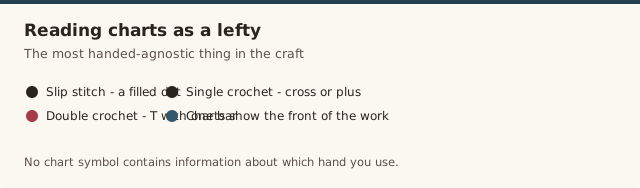
What that means in practice is beautiful: you read the exact same chart a right-handed crocheter reads, and you do not mirror a thing. A right-handed crocheter starts at the bottom-right corner of the chart and works the first row right to left, then turns and works the second row left to right, alternating all the way up. You start at the bottom-left corner and work the first row left to right, then turn and work the second row right to left. The chart is identical; you simply begin at the opposite corner and travel the opposite way. No redrawing, no mirroring, no mental gymnastics.
This is why so many of my left-handed students end up preferring charts over written right-handed photo tutorials. The moment the instruction stops being "look at my hands and copy" and becomes "put this symbol in this position," handedness stops mattering entirely. If you have ever felt like written patterns were written in a foreign language, spend a week with our guide to reading crochet charts and see whether the symbols feel more natural to you. For a lot of lefties, they do.
Adapting video tutorials
Video tutorials are where left-handed beginners hit the most friction, because almost all of them are filmed by right-handed makers. The good news is that every one of them is still usable — you just need a way to flip the picture. The lowest-tech method is the one I hand out most often: hold your phone or tablet up to a mirror and watch the reflection. It sounds silly, but it works, and my students have used everything from a bathroom mirror to a makeup mirror propped behind the phone.
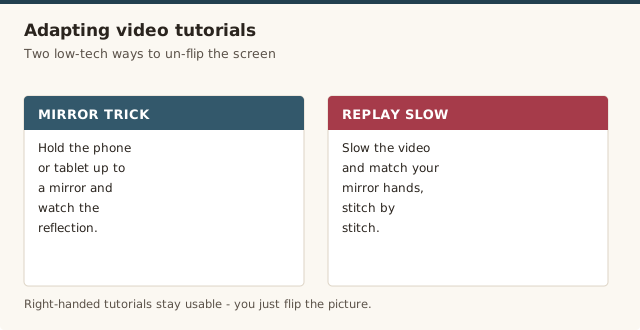
If a mirror is impractical, there are browser extensions and apps that mirror a video horizontally in real time, which is the digital version of the same trick. On YouTube, some left-handed crochet channels post mirrored versions of tutorials, so it's worth searching for "left-handed" plus whatever technique you're learning before you resign yourself to squinting at a reflection.
There's also a middle path I teach once someone has a little confidence: stop watching the hook hand and watch the yarn hand instead. In a right-handed video, the yarn is in the left hand; in your work, it's in your right. If you mentally substitute "yarn hand" for "left hand" and "hook hand" for "right hand," you can often follow along without any mirroring at all, because the relative motion — yarn over the hook, pull through the loop — is the same either way. It takes a little practice, but once the flip clicks, you'll never need the mirror again.
Common mistakes & fixes
Frequently asked questions
Is left-handed crochet different from right-handed crochet?
The stitches are exactly the same; only the direction changes. A left-handed crocheter works the mirror image of a right-handed crocheter, so you hold the hook in your left hand, the yarn in your right, and progress from left to right across the row instead of right to left.
Do I need special left-handed hooks or yarn?
No. Crochet hooks are not handed, so the same smooth hook works in either hand. You also don't need left-handed patterns; any written pattern can be followed by mirroring the direction, and charts are handed-agnostic by design.
How do I mirror a right-handed crochet pattern?
Work the exact same stitches but in the opposite direction, moving from left to right across your row instead of right to left. If the pattern is symmetrical, which most beginner projects are, simply follow it as written and the finished piece will come out correctly.
Can I learn from right-handed video tutorials?
Yes. Hold your phone or tablet up to a mirror to see the motion reversed, or use a browser extension that mirrors the video. As you get comfortable, your brain learns to flip the motion automatically, and you'll stop needing the mirror.
Are crochet charts easier for left-handed crocheters?
Often yes. A chart shows stitches as symbols with no direction baked in, so a left-handed crocheter reads the same chart the same way a right-handed crocheter does, simply starting at the opposite corner. Many lefties find charts simpler than translating right-handed photos.
Which stitch should a left-handed beginner learn first?
Chain stitch, then single crochet, exactly like a right-handed beginner. The order is the same; only the hand positions are reversed. Those two stitches are enough to complete a whole first project.
Why does my left-handed work look mirrored compared to the photo?
It's meant to. Your finished piece is the mirror image of a right-handed photo, so a texture or shaping detail that leans one way in the pattern photo may lean the other way in your hands. As long as the stitch count and structure match, it's correct.
CrochetGuides is a participant in the Amazon Services LLC Associates Program. As an Amazon Associate we earn from qualifying purchases, at no extra cost to you.