Free Crochet Baby Overalls Pattern (Button Straps)
Straight-leg dungarees with adjustable button shoulder straps, worked in half double crochet cotton for softness that actually stretches with a wriggling baby.
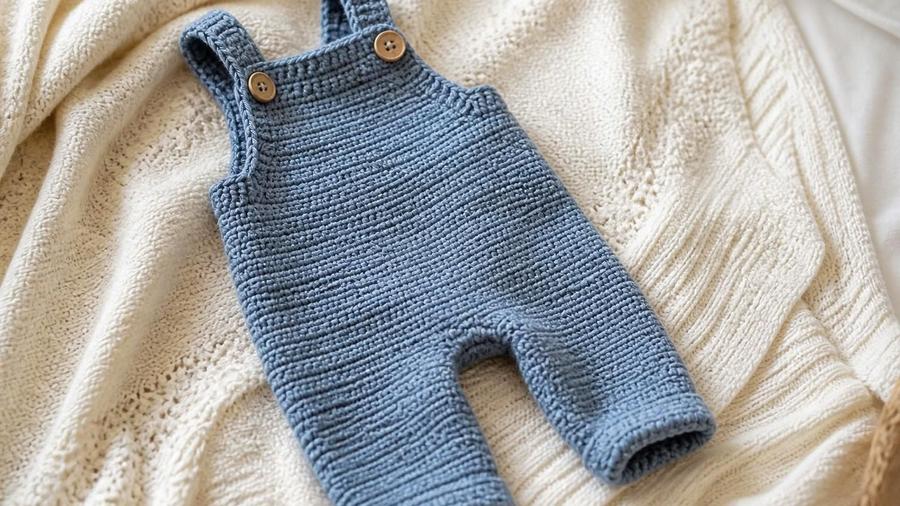
The first pair of baby overalls I made used plain single crochet, the same stitch I use for almost everything, and they came out about as stretchy as a cardboard box. Babies do a lot of unexpected bending, kicking, and general full-body wriggling, and a fabric with zero give fights that at every diaper change. Switching to half double crochet solved it almost entirely: it's still a firm, sturdy fabric, but the taller stitch has just enough natural give to move with a baby instead of resisting them.
The construction itself is refreshingly simple for a garment: two straight leg panels, seamed together at the inseam and down the front and back center, with the waist and leg openings left open. Two straps, worked as flat foundation chains rather than rolled tubes, cross at the back and button to the front waistband. That's genuinely the whole garment, no complicated shaping, just careful attention to the parts that matter most for a baby item: secure fasteners, safe seams, and yarn that survives repeated washing.
Below is the full pattern in US terms, sized for 0-3 months with a straightforward adjustment for 6-12 months, plus a cloth-diaper sizing variant, since that extra bulk through the seat genuinely changes what "fits" means for this particular garment.
Materials
- About 250–300 yards of DK-weight cotton yarn (0-3mo; see sizing for 6-12mo)
- 4mm (US G-6) crochet hook
- 2 buttons, about 3/4in / 2cm, plus reinforcement discs or fabric scraps for backing
- Yarn needle, scissors, sewing needle and strong thread for buttons
- Stitch marker
Abbreviations (US terms)
| Abbr. | Means |
|---|---|
| ch | Chain |
| sc | Single crochet |
| hdc | Half double crochet |
| FPdc/BPdc | Front-post / back-post double crochet (for ribbed cuffs) |
| st(s) | Stitch(es) |
See our abbreviations glossary for the full list including UK terms.
Gauge
14 hdc and 10 rows measures about 4in / 10cm square with a 4mm hook and DK-weight cotton.
Notes
- Worked flat in rows, in half double crochet throughout unless the ribbed cuff or straps section says otherwise.
- Make 2 identical leg panels before seaming.
- Sized for 0-3 months in the main pattern, with adjustments for 6-12 months in the sizing section.
Pattern
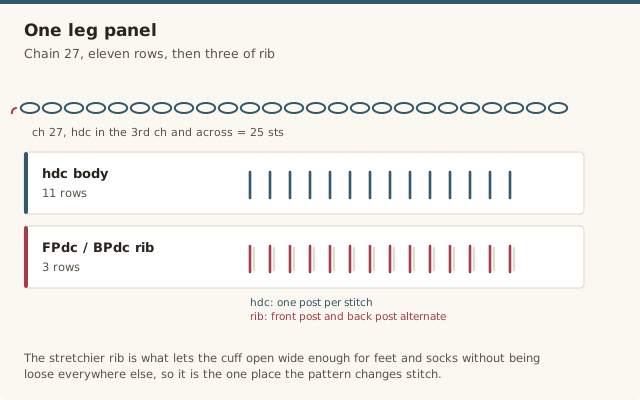
Chain 27. Hdc in 3rd ch from hook and each ch across (25 sts). Ch 2, turn. Hdc in each st across. Repeat for 11 rows total. (25 sts each row)
Ch 2, turn. [FPdc around next st, BPdc around next st] repeat across for a stretchy ribbed edge (25 sts). Repeat for 3 rows. Fasten off. This stretchier rib, rather than plain hdc, is what lets the cuff open wide enough for feet and socks without being loose the rest of the time.
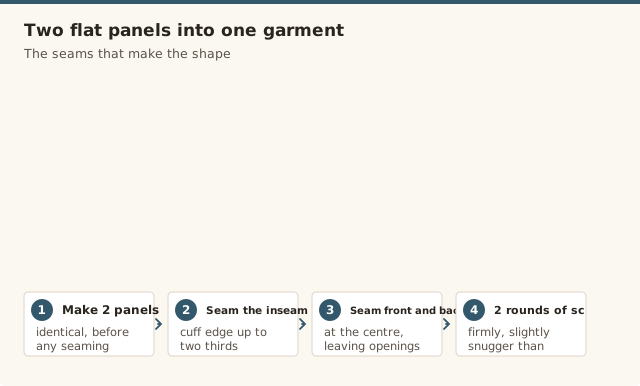
With both leg panels' cuffs at the bottom, seam the two panels together up one side (the inseam) from the cuff edge to about 2/3 of the way up. Seam the remaining top portions together at the center front and center back, leaving the waist opening and both leg openings open. This forms the seat and waist of the overalls from the two flat panels.
Join yarn at the waist opening. Work 2 rounds of sc firmly around the entire waist, worked slightly snugger than body gauge for a stable, non-stretchy band.
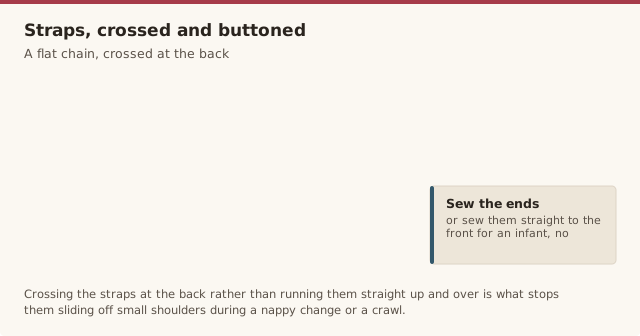
Chain 32 (adjust length to the wearer if you have their measurements). Sc in 2nd ch from hook and each ch across (31 sts). Ch 1, turn, sc across for 1 more row. Fasten off, leaving a tail. A flat chain foundation, rather than a rolled or folded tube, is what keeps these straps from twisting when worn.
Sew one end of each strap securely to the back waistband, spaced evenly. Cross the straps at the back and bring them over the shoulders to the front waistband. Mark where each strap end reaches the front, and sew a reinforced button there. Attach the strap ends with buttonholes (a small chain loop worked into the last row) or, for extra security with an infant, sew the strap ends directly to the front waistband instead of using a removable button closure. Crossing the straps at the back, rather than running them straight up and over, also helps keep them from sliding off small shoulders during a diaper change or a particularly enthusiastic crawl.
Sizing for 0-3 and 6-12 months
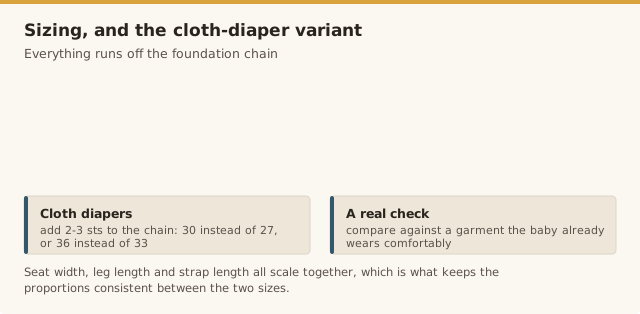
The pattern above is written for 0-3 months, roughly 8-13lbs. For 6-12 months, roughly 16-22lbs, chain 33 instead of 27 for each leg panel (31 sts after the turning row), work 15 rows instead of 11 before the ribbed cuff, and lengthen each strap to chain 38 instead of 32. These adjustments scale the seat width, leg length, and strap length together, keeping the overalls' proportions consistent between sizes.
Babies grow at wildly different rates even within the same rough age bracket, so treat these two sizes as starting points rather than guarantees. If you have the wearer's actual measurements, comparing them to a similar store-bought garment they already wear comfortably is a more reliable sizing check than age alone.
Fitting for cloth diapers
Cloth diapers add noticeably more bulk through the seat than disposables, and a pattern sized for disposables alone can pull uncomfortably tight there. If you know the wearer uses cloth diapers, add 2-3 extra stitches to each leg panel's foundation chain (so 30 instead of 27 for the 0-3 month size, or 36 instead of 33 for 6-12 months) before working the rest of the panel identically. This extra seat width doesn't meaningfully change the fit anywhere else on the garment.
Yarn choice & care
Cotton or a cotton-blend yarn is what this pattern is written for, since it breathes well against a baby's skin and holds its shape through repeated machine washing far better than pure acrylic, which tends to grow slightly baggy after a few wash cycles. Machine wash on a gentle cycle and lay flat to dry, checking the button attachments and strap seams after every wash, since that's exactly when a loosely sewn fastening tends to work itself free.
A garment this actively worn also benefits from having two on hand if you're making it for daily use rather than a one-off outfit, since laundry day shouldn't mean a baby has nothing to wear. If you're gifting a single pair, mentioning the care instructions to the recipient is worth the extra sentence, since not everyone assumes handmade cotton needs the same gentle treatment as a store-bought item.
Fit and durability fixes
Fix: add 2-3 extra stitches to the leg panel's seat width, noted as a sizing variant above, rather than trying to stretch a disposable-sized panel to fit.
Fix: reinforce each button with a small fabric or crochet backing disc on the wrong side, not just yarn thread through the button holes alone, and re-check all buttons after every wash.
Fix: work the cuffs in a stretchier front-post/back-post ribbing rather than plain single or half double crochet, which gives the opening real give without loosening the rest of the leg.
Fix: crochet the straps as a flat foundation chain worked in rows, not a rolled or folded tube, which is what causes the twisting in the first place.
Fix: use cotton or a cotton-blend yarn rather than pure acrylic, which this pattern's gauge and fit assumes; acrylic tends to stretch and not fully recover the way cotton does.
Our pick
Lion Brand 24/7 Cotton Yarn
A soft, machine-washable DK-weight cotton with good stitch definition, comfortable against a baby's skin and sturdy enough for a garment worn and washed often.
View on Amazon →Baby overalls FAQ
What's the sizing chart by age and weight?
The main pattern is written for 0-3 months (roughly 8-13lbs). The sizing section gives the exact stitch and row adjustments for 6-12 months (roughly 16-22lbs), mainly through wider panels and longer legs.
What's the best machine-washable yarn for this pattern?
A DK-weight cotton or cotton-blend yarn is what this pattern is written for, since cotton breathes well against skin and holds its shape wash after wash. Pure acrylic will work but tends to grow slightly baggy over repeated washing, which cotton resists better.
How do I adjust the fit for cloth diapers?
Add 2-3 extra stitches to the seat width when working the leg panels, noted as a variant in the pattern, to leave enough room for a cloth diaper's extra bulk without the overalls pulling tight through that area.
How do I reinforce buttons safely for an infant?
Sew buttons on with strong thread doubled through the button and fabric multiple times, backed with a small scrap of fabric or a flat crochet disc on the wrong side for extra hold, and check them before every wear. For a baby who mouths things frequently, a sewn-on strap loop closed with a few firm stitches is an even safer alternative to a button.
What are good layering ideas for different seasons?
A short or long-sleeved onesie underneath works for cooler weather, turning the overalls into a full outfit rather than a standalone piece. For warmer weather, a plain bodysuit or nothing at all underneath keeps the breathable cotton doing its job without adding extra layers.
When's the best time to gift baby overalls, before or after birth?
After birth, or very close to the due date, is safer for sizing accuracy, since babies vary quite a bit in size at birth regardless of due date. If gifting before birth for a baby shower, sizing for 6-12 months rather than newborn gives more room for the baby to grow into it.
How much yarn do I need?
About 250-300 yards of DK-weight cotton for the 0-3 month size, and 350-400 yards for 6-12 months, including the button straps.
Can I adapt this into a onesie or full romper bottom instead of full-length legs?
Yes, work the leg panels only 2-3in / 5-7cm long instead of to full length, then finish with the same ribbed cuff, which converts this into a shorts-length romper bottom using the identical panel and strap construction.
CrochetGuides is a participant in the Amazon Services LLC Associates Program. As an Amazon Associate we earn from qualifying purchases, at no extra cost to you.