Free Crochet Shawl Pattern (Triangular Lace)
A triangular wrap that starts as a single point at the neckline and fans outward, with an open mesh lattice body that drapes rather than a dense, heavy fabric.
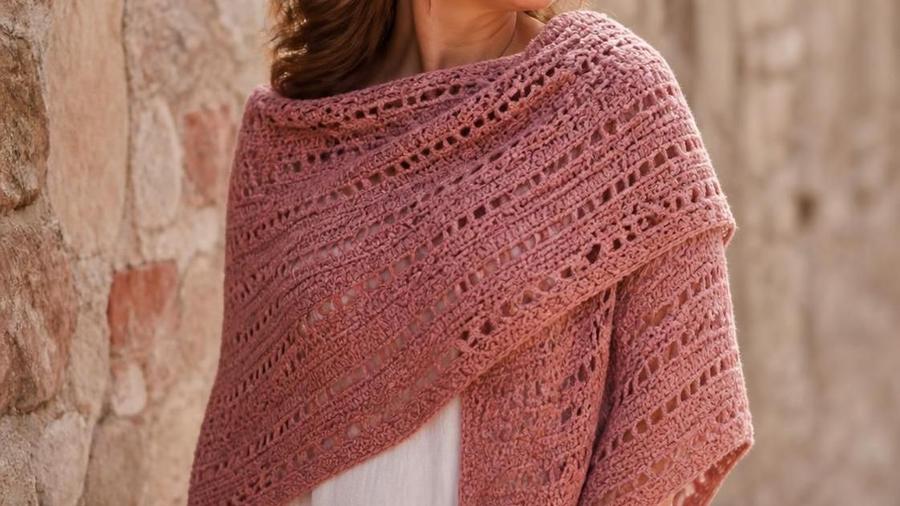
My first crochet shawl came out looking more like a stiff felted triangle than something anyone would actually want draped over their shoulders. I'd used the same worsted-weight yarn and gauge I'd use for a blanket, on the theory that a denser fabric would be sturdier. It was sturdy, and completely wrong for the job. A shawl's whole purpose is to move with the body, drape softly, and let some air through, and a tight, heavy fabric does none of that.
The fix was almost entirely about gauge and yarn choice rather than the stitch pattern itself. Once I switched to a lighter DK-weight yarn and deliberately went up a hook size from what the label suggested, the exact same triangle shape suddenly draped the way a shawl is supposed to. The mesh lattice body, worked in double crochet with open chain-spaces, does the rest of the work, letting light and air through in a way a solid fabric never could.
This pattern is worked top-down, starting from a single point at the back of the neck and increasing steadily at the center to fan the fabric out into a full triangle. It's a genuinely good first-shawl project precisely because the increase happens in the same predictable spot every single row; once you've got that rhythm, the rest is just repetition.
Below is the full pattern in US terms, along with the gauge and fiber reasoning behind why a shawl wants a looser hand than most other crochet projects, sizing notes for scaling the triangle up or down, and a home blocking method that doesn't require any special equipment beyond pins and a flat surface.
Materials
- About 600–700 yards of DK-weight or light worsted yarn
- 4-4.5mm crochet hook (a size up from what the yarn label suggests, for drape)
- Yarn needle, scissors, stitch marker
- Rustproof pins for blocking
Abbreviations (US terms)
| Abbr. | Means |
|---|---|
| ch | Chain |
| sc | Single crochet |
| dc | Double crochet |
| st(s) | Stitch(es) |
See our abbreviations glossary for the full list including UK terms.
Gauge
Gauge is intentionally loose here. Aim for a fabric that drapes easily over your hand rather than one that holds a rigid shape, going up a hook size from the yarn's suggested size if needed.
Notes
- Worked flat in rows, top-down, starting from a small point and increasing at the center every row.
- Place a stitch marker in the center chain-space and move it up every row so the increase point never drifts.
- The mesh body repeat can be worked for more or fewer rows to size the shawl up or down; see the sizing section.
Pattern
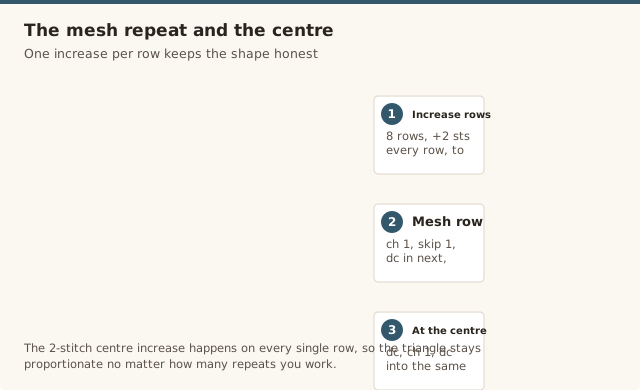
Chain 6. Sc in 2nd ch from hook and each ch across (5 sts). Ch 1, turn.
Sc in first st, 2 sc in next st (center increase), sc across to last st, 2 sc in last st. Ch 1, turn. Repeat for 8 rows, increasing by 2 sts every row. (21 sts after row 8) Place a stitch marker in the center 2-sc increase point of the most recent row before continuing, and move it up every subsequent row.
Ch 3 (counts as first dc), dc in same st. *Ch 1, skip 1 st, dc in next st* repeat across to the marked center point. At the center: dc, ch 1, dc into the same stitch (this is the center increase). Continue the *ch 1, skip 1, dc* pattern to the last st, ending 2 dc in last st. Ch 3, turn. Move the stitch marker up into the new center ch-1 space each row.
Work 1 round of sc evenly around the two angled edges of the triangle (not the straight top neckline edge). Then work a simple picot edge: *sc in next st, ch 3, sl st into first of those 3 ch, sc in same st* repeat evenly across both angled edges. Fasten off and weave in ends.
Gauge and why drape matters more than density
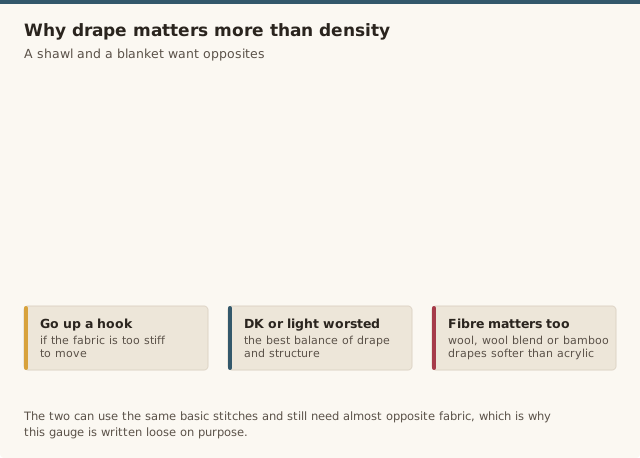
A shawl and a blanket might use the same basic stitches, but they need almost opposite fabric qualities. A blanket wants density and structure so it holds heat and doesn't sag; a shawl wants movement, so it drapes over the shoulders rather than sitting like a stiff board. That's the whole reason this pattern calls for going up a hook size from what the yarn label suggests: a slightly looser gauge is a deliberate choice here, not a mistake to correct.
Fiber choice compounds this. A wool, wool-blend, alpaca-blend, or bamboo-blend yarn drapes noticeably better than a stiff, springy acrylic at the same gauge, since natural and semi-natural fibers tend to relax and hang rather than holding their shape rigidly. If your finished shawl still feels stiffer than you'd like after blocking, the fiber is often the bigger factor to reconsider, not just the hook size.
It's worth swatching both the base rows and a section of the mesh body before committing to a full skein purchase, since the two sections behave differently even at the same gauge; the denser base rows will always feel firmer in hand than the open lattice above them, and that's expected rather than a sign something's off.
Sizing the shawl up or down
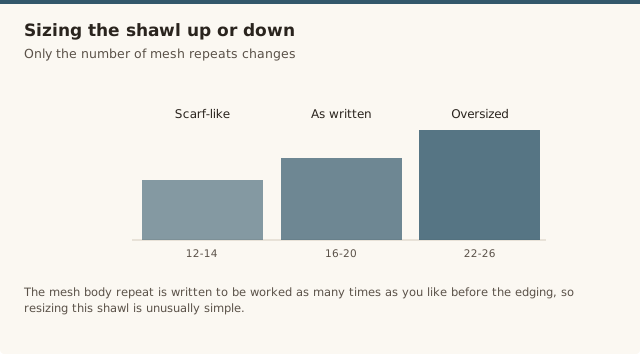
The mesh body repeat row is written to be worked as many times as you like before moving on to the edging, which makes resizing this shawl unusually simple. Working fewer repeats (12-14 instead of 16-20) produces a smaller, more scarf-like wrap; working more (22-26) produces an oversized, blanket-style shawl with real coverage. Because the same 2-stitch center increase happens every single row regardless of how many repeats you work, the proportions stay correct at any size, the triangle just grows or shrinks uniformly.
Blocking a lace shawl at home
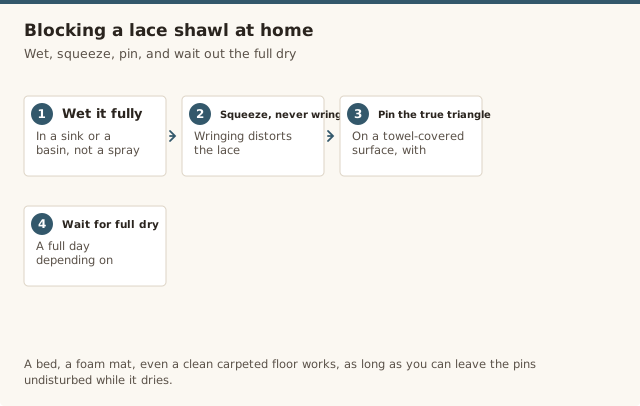
Blocking is what turns a slightly curled, irregular piece of mesh into a crisp, evenly-spaced triangle, and it doesn't require special equipment. Wet the finished shawl completely in a sink or basin, gently squeeze out the excess water without wringing or twisting the fabric, then lay it out on a towel-covered flat surface, a bed, a foam yoga mat, even a clean carpeted floor works. Pin the two angled edges out to the true triangle points using rustproof pins, checking the shape with a tape measure if you want precise symmetry, and leave it completely undisturbed until fully dry, which can take a full day depending on your yarn and the room's humidity.
Where shawls typically go wrong
Fix: go up a hook size from what the yarn label suggests. Shawls want a looser gauge than most other crochet projects, since drape matters more than a tight, structured fabric.
Fix: block the finished piece wet, pinned out to the true triangle shape, and let it dry fully before unpinning; curling almost always relaxes out with proper blocking.
Fix: place a stitch marker directly in the center chain-space and increase into it every single row, recounting your total stitch count every 10 rows to catch any drift early.
Fix: weigh the first third of the finished shawl on a kitchen scale and multiply by three for a realistic total yardage estimate, rather than guessing how many skeins to buy up front.
Fix: count the chains in each space as you work rather than eyeballing the spacing, especially in dim lighting where a 1-chain and 2-chain space can look deceptively similar.
Our pick
Lion Brand Heartland Yarn
A soft, lightly variegated DK-weight yarn with good drape, well suited to a lace mesh pattern that benefits from movement rather than stiffness.
View on Amazon →Shawl FAQ
What's the best yarn weight and fiber for a shawl to drape well?
DK weight or a light worsted gives the best balance of drape and structure for this shape. Fiber matters as much as weight: a wool, wool blend, or bamboo blend drapes noticeably softer than a stiff acrylic, though a good acrylic works fine if that's what's available.
How do I block a lace shawl without special equipment?
Wet the finished shawl fully, squeeze out excess water without wringing, then pin it out to the true triangle shape on a towel-covered surface (a bed, a foam mat, even a clean carpeted floor works) using rustproof pins. Leave it fully dry before unpinning, which can take a full day depending on humidity.
Can I make this shawl bigger or smaller than the pattern's size?
Yes, simply work more or fewer mesh-lattice repeat rows than the pattern specifies before starting the edging. Each repeat row adds a consistent, predictable amount to both the width and depth of the triangle, so it's easy to stop earlier for a smaller shawl or continue longer for an oversized wrap.
How much yarn do I need for this shawl?
For the size given in this pattern, budget 550-700 yards of DK-weight yarn, more toward the higher end for a larger frame or an extra-long wrap. Weighing the first third of your shawl and multiplying by three gives a far more reliable estimate than guessing skein count up front.
What are the different ways to wear or style this shawl?
The classic wear is draped over both shoulders with the point hanging down the back, but it also works folded in half and worn as a scarf, wrapped once around the neck and let the ends hang, or pinned closed at the front with a shawl pin or brooch for a more tailored look.
Does this pattern work with variegated yarn?
Yes, and the mesh lattice sections actually show off variegated colour changes nicely, since the open spaces let each colour transition read clearly rather than blurring together the way a denser stitch would. A shorter colour-repeat length tends to look better in this pattern than a very long, slow gradient.
How long does this shawl take to make?
Most confident beginners finish in 8-12 hours of crocheting time, spread across several sessions, since the pattern repeats become quick to work once the rhythm is established. The edging and blocking add another hour or two at the end.
What occasions is a crochet shawl a good gift for?
It suits almost any gifting occasion where a soft, wearable accessory makes sense: a birthday, a wedding or anniversary in a meaningful colour, a new-mother gift for wrapping up on the couch, or a thoughtful sympathy or get-well gift, since a shawl reads as comforting rather than purely decorative.
CrochetGuides is a participant in the Amazon Services LLC Associates Program. As an Amazon Associate we earn from qualifying purchases, at no extra cost to you.