Free Crochet Cowl Pattern for Beginners
A closed loop worked in half double crochet, no ties or ends to manage — just slip it over your head.
My first cowl came out with a permanent twist in it — a subtle mobius kink I didn't notice until I'd worked six rounds past the join, by which point I couldn't bear to rip it out. I wore it for an entire winter, quietly annoyed every time I pulled it over my head, before finally admitting the twist bothered me enough to start over. In my classes now I watch for that exact moment, when a student's starting chain goes slightly out of true just before the slip stitch. Ten seconds laying the chain flat and running a finger along its whole length would have saved me a whole winter of a crooked cowl. It's the first thing I teach here, because it's the one mistake this pattern will not let you hide.
Materials
- 2 skeins worsted-weight yarn (about 200–250 yards total)
- 5.5mm (US size I) crochet hook
- Stitch marker, to track the start of each round
- Scissors
- Yarn needle, for weaving in ends
Abbreviations (US terms)
| Abbr. | Means |
|---|---|
| ch | Chain |
| hdc | Half double crochet |
| st(s) | Stitch(es) |
| rnd(s) | Round(s) |
See our abbreviations glossary for the full list including UK terms.
Gauge
12 hdc and 10 rows measures about 4in / 10cm square with a 5.5mm hook and worsted yarn. The finished circumference depends directly on your starting chain — measure loosely around the neck and shoulders before starting.
Notes
- Written in US terms, worked in a continuous spiral — use a stitch marker to track round starts, same technique as our beanie pattern.
- The numbers below make a single-loop cowl that sits at the collarbone; see the FAQ for how to size up to a double loop.
- Check the starting chain against the wearer before joining into a round — it should slip over the head comfortably.
Pattern
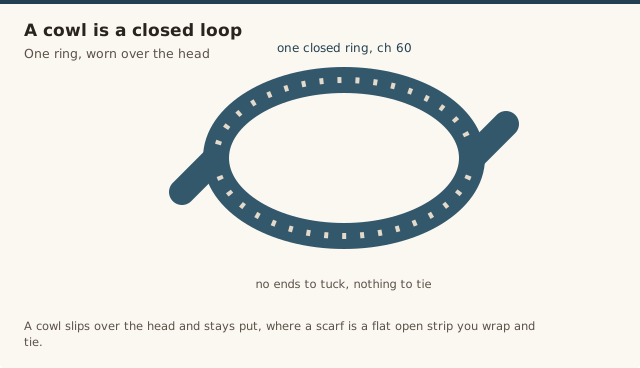
Ch 60, join with a sl st to form a ring, being careful not to twist the chain. Place marker. (60 sts)
Hdc in every st around. (60 sts each round)
Continue until the cowl measures about 9in / 23cm tall, roughly 14 rounds for this gauge.
Fasten off and weave in all ends with a yarn needle.
A full walkthrough of crocheting a neck-warming cowl, useful for seeing how the piece is joined into a continuous loop.
Changing the drape
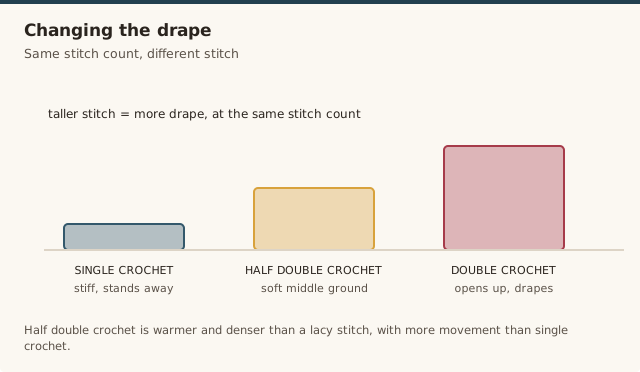
Half double crochet gives this cowl a soft middle ground — warmer and denser than a lacy stitch, but with more movement than a stiff single crochet fabric. If you want a cowl that hangs and folds more like a scarf, swap in double crochet at the same stitch count; the taller stitch opens the fabric up and lets it drape rather than stand away from the body. For a chunkier, more structured cowl that holds its shape well, single crochet in the same rounds gives a denser result, though it will use noticeably more yarn for the same finished height. The yarn itself also changes how it drapes — our yarn weight guide explains how weight affects the finished feel.
A simple mesh pattern (alternating chain-1 spaces with double crochet) is another easy swap for a lighter, more breathable cowl suited to milder weather, without changing the basic construction of joining a tube and working rounds straight up.
Common mistakes & fixes
Fix: lay the chain flat on a table and run a finger along its entire length to check for a twist before joining with the slip stitch — it's much easier to catch and fix before round 1 than after several rounds are worked.
Fix: wrap the starting chain loosely around the neck and shoulders before joining, adding or removing chains in multiples of 2 until it slips over comfortably with a little room to spare.
Fix: switch to a taller, more open stitch like double crochet or a mesh pattern, described above, which drapes more naturally than dense half double or single crochet.
Our pick
Cotton worsted-weight yarn, 3-pack
Two of the three skeins covers this project, with the third left over for a matching accessory.
View on Amazon →Frequently asked questions
What is the difference between a cowl and a scarf?
A cowl is a closed loop that slips over the head, while a scarf is a flat, open strip that gets wrapped and tied. Cowls tend to stay in place better and have no loose ends to manage.
How much yarn do I need for a crochet cowl?
A single-loop cowl uses roughly 200 to 250 yards of worsted-weight yarn, comfortably within two standard skeins.
Can I make this cowl pattern longer for a double loop?
Yes, work more rounds before joining to create a longer tube that wraps twice around the neck, roughly doubling the round count and yarn needed.
How do I stop a crochet cowl from twisting when I join it into a loop?
Lay the starting chain flat on a table before joining and run a finger along its full length to check for a twist, since even a half-turn will show up as a permanent kink once the round is joined and worked.
What crochet stitch gives a cowl the best drape?
Taller, more open stitches like double crochet or a simple mesh pattern drape better than dense single crochet, which tends to sit stiffer and more structured around the neck.
Can I make this cowl with a different yarn weight?
Yes — lighter yarn makes a softer, more drapey cowl while chunkier yarn makes a warmer, more structured one, but you'll need to adjust the starting chain to match, since the finished circumference depends directly on how many chains you start with.
How many chains do I need for a child's cowl?
The starting chain should be long enough to slip comfortably over the child's head with a little room to spare, which usually means starting with fewer chains than the adult size. Measure the chain loosely around the head before joining and adjust in multiples of 2 rather than following a fixed number.
CrochetGuides is a participant in the Amazon Services LLC Associates Program. As an Amazon Associate we earn from qualifying purchases, at no extra cost to you.