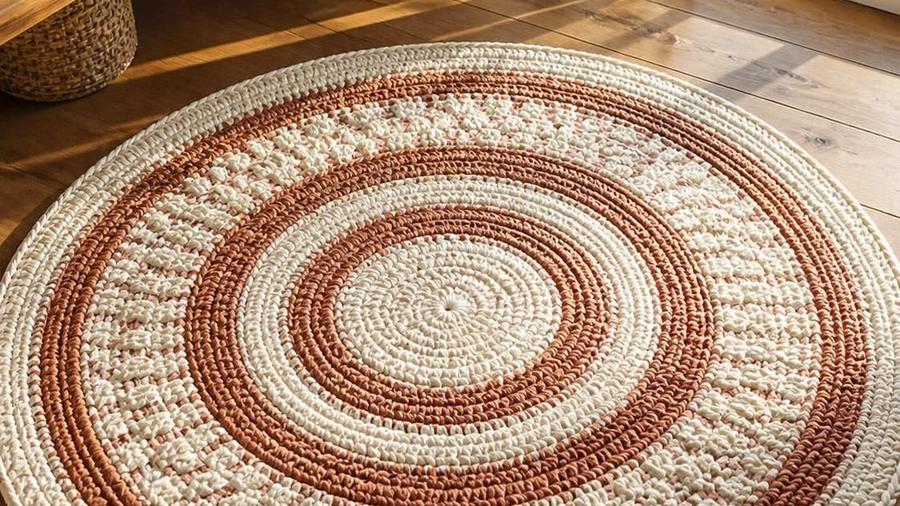
A round floor rug worked from the center out in jumbo or super-bulky yarn, using an increase rate scaled specifically for thicker fiber.
Updated 2026 · US terms · Works with jumbo yarn or T-shirt yarn strips
I made my first jumbo-yarn rug using the exact same increase math I'd use for a worsted-weight coaster, just scaled up in size, and ended up with something that rippled at the edges like a lettuce leaf. It took me longer than it should have to realize the problem wasn't the yarn or the hook, it was the math itself: the standard "6 new stitches per round" rule that keeps a thin-yarn circle flat assumes a certain relationship between stitch width and row height that simply doesn't hold once the yarn is thick enough that each stitch covers several times the distance a worsted-weight stitch would.
This pattern covers the adjusted, scaled-down increase rate that actually keeps a jumbo-yarn rug flat, plus the durability and non-slip considerations that matter for something that's going to live on a floor and get walked on, rather than sit decoratively on a shelf.
A jumbo rug is also one of the fastest big projects a crocheter can make, since each stitch covers so much more ground than a standard worsted-weight stitch. A 3ft rug that might take dozens of hours in worsted weight can come together in a handful of evenings in jumbo yarn, which makes this a good weekend project when you want a real, sizeable finished piece without the time investment a similarly-sized worsted-weight blanket would need.
Worked flat from the center out in continuous rounds; the increase rate below is scaled specifically for jumbo/super-bulky yarn, not the standard worsted-weight rate.
T-shirt yarn and standard jumbo yarn use the same round-by-round math; only the hook size may need to change slightly between them.
Pattern
Rounds 1-2
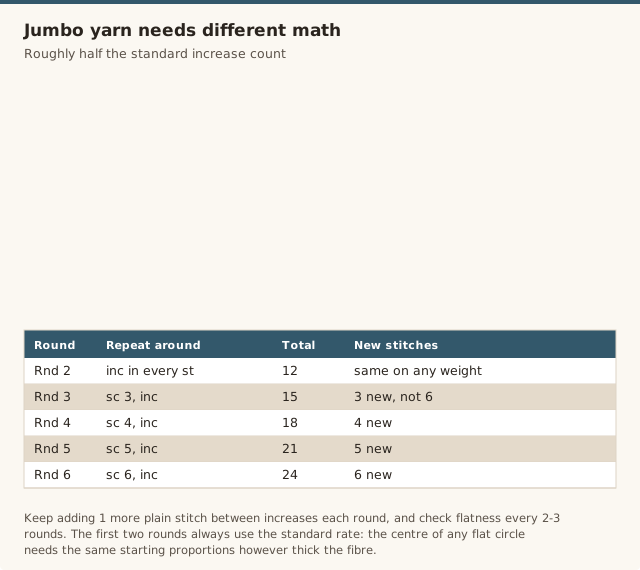
Magic ring, 6 sc into ring (6). Rnd 2: inc in every st (12). These first two rounds follow the standard rate regardless of yarn weight, since the very center of any flat circle needs the same starting proportions no matter how thick the fiber is.
Rounds 3-6 (scaled rate)
Rnd 3: *sc 3, inc* around (15, adding only 3 new sts rather than 6). Rnd 4: *sc 4, inc* around (18). Rnd 5: *sc 5, inc* around (21). Rnd 6: *sc 6, inc* around (24). This scaled rate, adding roughly half the standard 6-per-round increase, is what keeps jumbo-weight fabric flat rather than ruffling.
Continue to target size
Keep following the pattern of adding 1 more plain stitch between increases every round (round 7 is *sc 7, inc*, and so on), checking flatness every 2-3 rounds and adjusting the rate slightly if the piece starts to cup or ruffle, until the rug reaches your target diameter.
Edging
Work 1 final round of plain sc (no increases) or reverse single crochet (worked left to right instead of right to left, for a corded, non-fraying look) around the outer edge. Fasten off and weave in ends securely, since a floor rug's ends see more friction than most projects and need to be tucked in well to avoid working loose over time.
Why jumbo yarn needs different math
The standard flat-circle rule (6 new stitches every round, for single crochet) is built around the proportions of a normal worsted-weight stitch, where the stitch's width and height are close enough in scale that the math works out cleanly. Jumbo yarn breaks that assumption because each stitch covers so much more physical distance that the same 6-per-round rate adds far more width than the round actually needs to stay flat, and the excess fabric ruffles at the edge exactly the way an over-increased thin-yarn circle would.
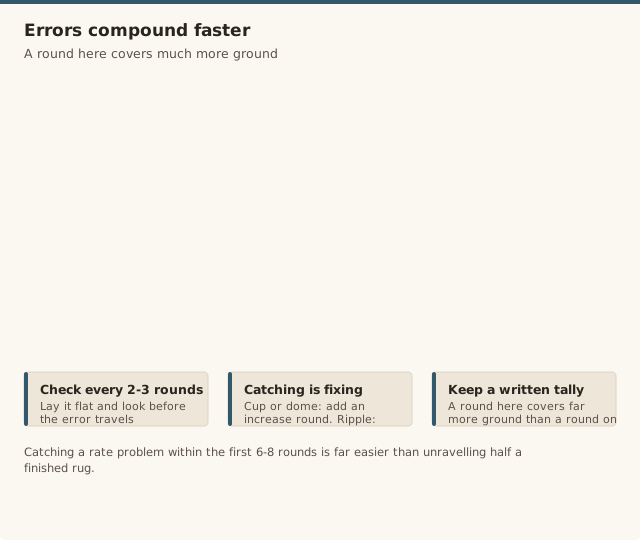
The adjusted rate in this pattern, roughly half the standard increase count, is a starting point rather than an exact universal formula, since jumbo yarns vary more in actual thickness between brands and fiber types than thinner weights do. Check your work's flatness every 2-3 rounds by laying it on a flat surface, and if it's starting to dome or cup, add an extra increase round; if it's rippling, skip an increase round. Catching this early, within the first 6-8 rounds, is far easier than unraveling half a finished rug.
Because each round of a jumbo rug represents a meaningfully larger jump in diameter than a round of thinner yarn would, small rate errors also compound faster in absolute terms. A miscount that would add an extra half-inch to a worsted-weight coaster might add two or three inches to a jumbo-yarn rug at the same round, which is part of why the frequent flatness checks matter more here than they would on a smaller, thinner-yarn project. Keeping a written tally of your stitch count at the end of each round, rather than trusting memory, is a small habit that pays off disproportionately on a project where each round covers this much ground.
Durability for foot traffic
A rug lives a harder life than almost any other crocheted item on this site, taking regular foot traffic, occasional spills, and being walked over rather than looked at. Fiber choice matters more here than the exact stitch pattern: T-shirt yarn (cut fabric strips) and cotton jumbo yarns hold their shape and resist flattening under repeated pressure noticeably better than a soft, plush novelty jumbo yarn, which can start looking matted and compressed within a few months of daily walking.
If you're using a variegated or multi-color jumbo yarn, working from two skeins alternately every 2 rounds rather than through one skein at a time evens out any color pooling that would otherwise show up as an uneven blotch pattern once the rug is finished and laid flat, where color inconsistencies are much more visible than they'd be in a smaller project.
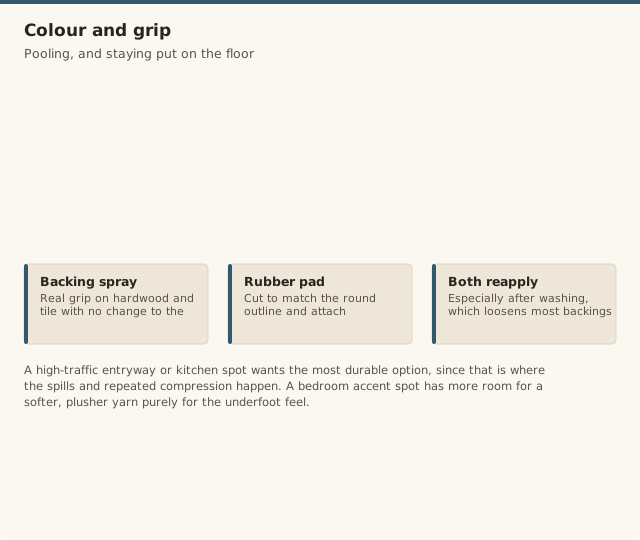
Where you plan to place the rug also matters for fiber choice. A high-traffic entryway or kitchen spot benefits from the most durable option, T-shirt yarn or a tightly-plied cotton, since that location sees the most repeated compression and the occasional spill. A bedroom or low-traffic accent spot has more room for a softer, plusher jumbo yarn purely for the underfoot feel, since it won't be subject to the same daily wear or need frequent washing.
Choosing colors and yarn source
A solid, single-color rug in a neutral like oatmeal, grey, or terracotta works in nearly any room and doesn't compete visually with other decor, which is part of why it's the most common choice for this style. A ring of contrast color, worked as 2-3 rounds partway through the piece rather than throughout, adds visual interest without the color-pooling risk that a fully variegated yarn carries.
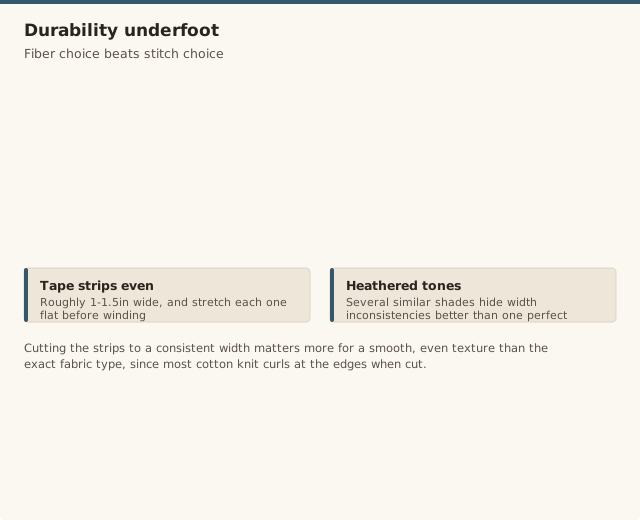
If you're making a T-shirt yarn version specifically to use up old fabric, cutting the strips a consistent width, roughly 1-1.5in, matters more for a smooth, even final texture than the exact fabric type. Stretch each cut strip gently before winding it into a ball, since most cotton knit fabric curls at the edges when cut and stretching it flat first makes for a more even width once crocheted, rather than a strip that curls unpredictably as you work.
Mixing several different T-shirts of similar but not identical colors, several shades of blue or several shades of grey, for instance, gives a heathered, tonal look that hides small width inconsistencies between strips far better than a rug relying on one single, perfectly uniform color would look.
Shape and durability mistakes
Mistake: the rug doesn't lie flat and ruffles at the outer edge.
Fix: too many increases for jumbo-weight yarn, the standard worsted-weight 6-per-round math doesn't scale directly, so drop back to fewer increase rounds and re-check flatness every few rounds.
Mistake: the rug domes or cups upward like a shallow bowl instead of lying flat.
Fix: the opposite problem, not enough increases, so add one extra increase round and re-check.
Mistake: the fabric shows visible gaps or uneven thickness between stitches.
Fix: jumbo yarn shows tension inconsistencies far more than thin yarn, so keep tension deliberately even round to round and never skip a stitch to stretch the yarn further.
Mistake: the finished rug slides around on hardwood or tile floors.
Fix: apply a non-slip rug backing spray to the underside, or cut and attach a thin rubber rug pad to match the rug's shape.
Mistake: colors pool unpredictably when using a variegated or multi-color jumbo yarn.
Fix: alternate between two skeins every 2 rounds rather than working straight through one skein at a time, which evens out the color distribution.
Our pick for grip
Home
Non-Slip Rug Backing Spray
A spray-on rubberized backing gives a jumbo-yarn rug real grip on hardwood and tile without changing its look or feel from the top, and reapplies easily after washing.
What yarn is most durable for a rug that gets regular foot traffic?
T-shirt yarn (fabric strips) or a jumbo-weight cotton or cotton-blend holds up best underfoot, resisting the flattening and pilling that a softer novelty jumbo yarn can show after regular walking traffic. Pure acrylic jumbo yarn works but flattens faster over time.
Can this rug be machine washed or does it need to be spot-cleaned?
This depends entirely on the yarn used: a cotton or acrylic jumbo yarn rug can often go in a large-capacity washing machine on a gentle cycle and air dry flat, while a T-shirt yarn rug is generally sturdier washed by hand or spot-cleaned, since machine agitation can stretch the fabric strips unevenly.
How large can it realistically be made with jumbo yarn?
Most crocheters find 3-4ft in diameter to be a practical upper limit for a hand-worked jumbo rug, both because of yarn quantity and because a very large piece becomes physically awkward to maneuver on your lap or table as you work each round.
What hook size pairs with jumbo/super-bulky yarn?
A 10-15mm hook is standard for jumbo yarn, though the exact size depends on the specific yarn's thickness. Always swatch a small section first, since jumbo yarns vary more in actual thickness between brands than thinner weights do.
Can T-shirt yarn or fabric strips be substituted for jumbo yarn?
Yes, and it's a popular substitution both for cost savings (using up old T-shirts) and for durability, since fabric strips generally hold up to foot traffic better than a soft novelty jumbo yarn. The same increase-round math applies regardless of which material is used.
How do I keep the finished rug from sliding on hard flooring?
Apply a non-slip rug backing spray to the underside, or cut and attach a thin rubber rug pad shaped to match the rug's round outline. Either option is a simple add-on rather than something worked into the crochet itself.
Nora has been teaching crochet for 12 years, from absolute beginners to people coming back to the craft after decades away. She started CrochetGuides to write the clear, honest instructions she wishes she'd had when she was learning — the ones that actually work the first time.
CrochetGuides is a participant in the Amazon Services LLC Associates Program. As an Amazon Associate we earn from qualifying purchases, at no extra cost to you.