Free Cozy Lapghan Pattern (Quick Navy & Cream Car Blanket)
Navy and cream stripes with a single row of raised bobbles running through the middle — a small, honest blanket sized to finish fast and live in the car.
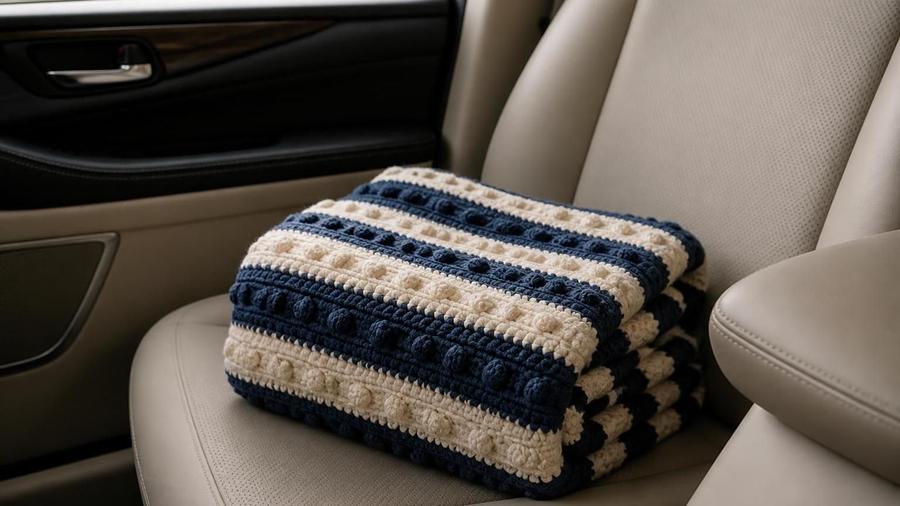
Not every blanket needs to be a months-long project. Some of my favorite things I've ever crocheted are the small ones: the lapghan I keep folded in the back seat for cold mornings, the one that lives over the arm of my reading chair, the one I made for my mother-in-law's wheelchair that's exactly the right size to tuck around her knees without dragging on the floor. Lapghans get overlooked because they're not dramatic, but they're the pattern I recommend most often to someone who wants to actually finish something this month.
This one is deliberately simple: straightforward double crochet worked in navy and cream stripes, with a single row of raised bobbles running across the middle to break up the stripes and give your hands something more interesting to do partway through. It's small enough that a confident beginner can finish it in a weekend, and it uses so little yarn that it's a genuinely economical way to use up a couple of coordinating skeins you already own.
Below is the full pattern in US terms, along with notes on choosing a stripe sequence, working the bobble accent row cleanly, and resizing the blanket if you want something a little bigger or smaller than the car-blanket size shown here. If you haven't worked stripes before, our guide to changing colors in crochet covers the technique from the start.
Materials
- About 500 yards of worsted-weight yarn in navy
- About 350 yards of worsted-weight yarn in cream
- 5.5mm (US I-9) crochet hook
- Yarn needle and scissors
Abbreviations (US terms)
| Abbr. | Means |
|---|---|
| ch | Chain |
| dc | Double crochet |
| sc | Single crochet |
| bobble | 5 incomplete dc in same st, closed with one pull through all loops |
| st(s) | Stitch(es) |
Gauge
12 dc and 7 rows measures about 4in / 10cm square with a 5.5mm hook and worsted yarn, measured over plain stripe rows before the bobble row is added.
Notes
- Change colors on the last yarn-over of the final stitch of a row, so the new color is already on the hook when you turn.
- Carry the color not in use loosely up the side edge rather than cutting it, since you'll switch back every 4 rows.
- The single bobble row replaces one navy stripe row near the vertical center of the blanket — it doesn't add extra rows to the total.
Pattern
In navy, chain 93. Double crochet in the 4th chain from the hook, and in each chain across. Turn. (90 sts)
Chain 2 (does not count as a stitch), double crochet in each stitch across. Turn. Repeat for 4 rows total in navy, changing to cream on the last stitch of Row 4.
Continue as above for 4 rows in cream, changing back to navy on the last stitch of Row 8.
Repeat the 4-row navy, 4-row cream sequence three more times (24 rows), keeping your stripe pattern consistent. You should now have 32 rows total.
In navy, chain 2, double crochet in the first 2 stitches. *Work a bobble in the next stitch: yarn over, insert hook in the stitch, pull up a loop, yarn over and pull through 2 loops (2 loops left on hook); repeat this 4 more times into the same stitch (6 loops on hook), then yarn over and pull through all 6 loops to close the bobble. Double crochet in the next 3 stitches; repeat from * across, ending with double crochet in the last 2 stitches. Turn.
This single row sits at the vertical center of the blanket and takes the place of what would otherwise be the third row of a navy stripe.
Finish Row 34 as a plain navy row to complete that navy stripe, then continue the 4-row navy, 4-row cream sequence for the remainder of the piece until it measures about 40in / 102cm long, roughly 70 rows total at this gauge, ending on a plain row.
In cream, work 2 rounds of single crochet evenly around all four edges, placing 3 single crochet in each corner on both rounds. Join with a slip stitch, fasten off, and weave in the ends.
Choosing your stripe sequence
Navy and cream is a classic, easy-to-pair combination that reads as tidy rather than busy, which is part of why it works so well on a small blanket meant to go in a car or diaper bag rather than sit as a statement piece on a sofa. The 4-row stripe width shown here is wide enough to read clearly from across a room but narrow enough that you never get bored working a single color for too long. If you'd rather a subtler look, try 6- or 8-row stripes instead; if you want something busier, drop down to 2-row stripes, though at that width you'll be changing colors often enough that it's worth reading our color-changing guide first so your edges stay neat.
Three-color stripe sequences also work well on this pattern; just repeat your 4-row blocks in whatever order you like, and adjust the yardage estimate up slightly to account for the extra color. Whatever sequence you settle on, it's worth writing it down before you start, the same way you would for a temperature blanket, so you don't lose track of where you are if you set the project down for a few days.
The bobble accent row
A bobble is built from 5 incomplete double crochet stitches, all worked into the same stitch, then closed together with one final pull. Unlike our dedicated bobble stitch throw blanket pattern, which repeats bobble rows throughout the whole piece for a heavily textured fabric, this lapghan uses just one bobble row, placed at the vertical center, as a single deliberate accent rather than an all-over texture. That was a conscious choice for this pattern: a lapghan is meant to be quick, and one bobble row adds visual interest without meaningfully slowing down the project the way a full bobble-row repeat would.
As you work the stitches after each bobble, gently press it toward the side of the fabric facing you so it consistently pops forward. If you'd like more texture, you're welcome to add a second bobble row a few stripes further along; the pattern will still work exactly the same way, it will simply take a little longer to finish.
Sizing up or down
To make this lapghan wider, add stitches in multiples of 4 to keep the bobble row's spacing even (each bobble sits 4 stitches apart), and add or remove full 4-row stripe blocks to change the length. At this gauge, 12 stitches equal about 4 inches, so each group of 4 added stitches adds a little over an inch of width. If you'd like a proper full-size throw instead of a lap-sized blanket, you can scale this same stripe-and-bobble structure up considerably; just keep an eye on your yarn quantities, since a much larger piece will need noticeably more of each color than the amounts listed here.
A blanket built to travel
Part of what makes a lapghan worth making, beyond how quickly it works up, is how much use it gets once it's off the hook. This size folds down small enough to live permanently in a car door pocket, a stroller basket, or a work bag, ready for a chilly waiting room or an unexpectedly cold office. It also makes a genuinely welcome gift for anyone in a wheelchair or recliner, where a full-size throw is often too bulky to manage but a lapghan sits perfectly over the knees. I've made several of these specifically as gifts for exactly that reason, and they're consistently the ones I hear got used the most.
Care & washing
Check your yarn's ball band before washing; most worsted acrylic and acrylic-blend yarns are fully machine washable on a gentle cycle, which matters for something that's going to live in a car and pick up dust and crumbs. Dry flat rather than in a hot dryer if your yarn label recommends it, since high heat can flatten the bobble row's texture over time. Our guide to washing crochet items covers fiber-specific advice if you're not sure what your particular yarn needs.
Common mistakes & fixes
Fix: keep a simple tally mark or row counter next to your project, and check it against the 4-row block pattern before every color change.
Fix: carry the resting color loosely up the edge of the work rather than cutting and rejoining it every 4 rows; it saves yarn and avoids extra ends to weave in.
Fix: make sure the carried strand isn't pulled taut along the side; leave it just slightly loose so the edge lies flat once blocked.
Fix: count your rows so the bobble row lands at roughly the halfway point of the finished length; it reads as an intentional accent there rather than an odd interruption near one edge.
Fix: pick colors with a clear difference in lightness, like the navy and cream shown here, rather than two similar mid-tones, so the stripe pattern stays visible even across the room.
Our pick
Caron Simply Soft Yarn
A smooth, affordable worsted-weight yarn available in a wide range of solid colors, including a true navy and a warm cream that pair well for this project.
View on Amazon →Frequently asked questions
What is a lapghan?
A lapghan is a small crochet blanket, usually somewhere around 30 by 40 inches, sized to cover your lap and legs rather than a whole bed or sofa. The name is a blend of "lap" and "afghan," and lapghans are a popular quick project because their smaller size means far less yarn and far fewer rows than a full-size throw.
How is a lapghan different from a regular throw blanket?
The main difference is simply size. A throw blanket is usually 50 inches or larger in each direction, while a lapghan is intentionally smaller and lighter, generally under 40 inches, so it's easy to fold into a bag, keep in a car, or finish in a weekend rather than several weeks.
Can I make this pattern in one color instead of stripes?
Yes. Simply work the entire body in a single color and skip the color changes described in the stripe sequence. The bobble accent row will still work exactly the same way and will show up nicely as a texture change even without a color change alongside it.
How long does a lapghan take to crochet?
Most confident beginners finish this pattern in a weekend or two of evening sessions, and experienced crocheters often finish it in a single weekend. At roughly 70 rows of straightforward double crochet, it's one of the fastest full blanket patterns on this site.
What size hook and yarn should I use for a lapghan?
This pattern uses a 5.5mm (US I-9) hook with worsted-weight yarn, which gives a fabric that's warm but not too heavy or stiff for a small blanket meant to travel with you. Going up a hook size will produce a looser, drapier fabric and use slightly less yarn; going down will produce a denser, warmer one.
Can I use this pattern as a car blanket?
Yes, that's exactly the size and weight it's designed for. A worsted-weight lapghan this size folds down small enough to keep in a car door pocket or under a seat, and machine-washable acrylic or acrylic-blend yarn holds up well to the temperature swings and occasional spills that come with car use.
CrochetGuides is a participant in the Amazon Services LLC Associates Program. As an Amazon Associate we earn from qualifying purchases, at no extra cost to you.