Tapestry Crochet: A Complete Tutorial
How to crochet a multi-color geometric or picture design into single crochet fabric by carrying the unused yarn.
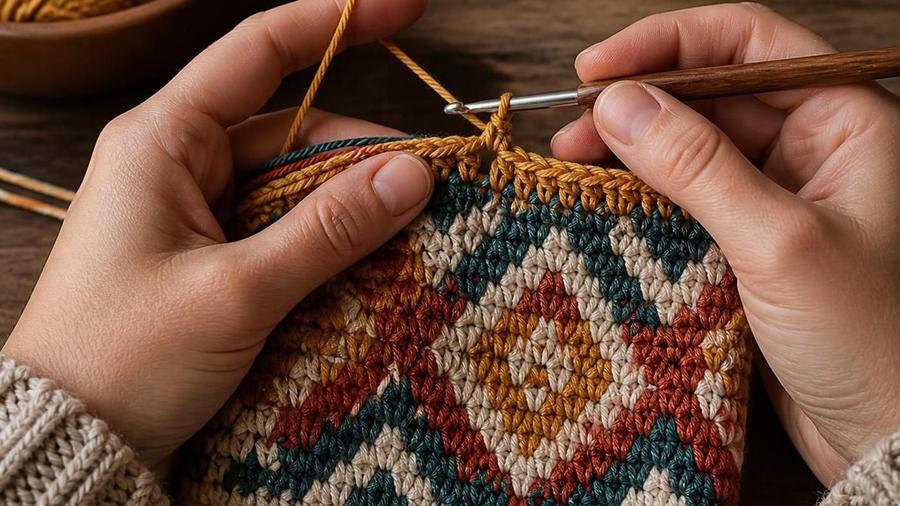
My first tapestry crochet swatch had a small, ugly secret: from the front it looked like a reasonably clean diamond motif, and from the back it looked like a yarn cyclone, loose loops of the unused color hanging everywhere I'd switched. It worked, technically, but the fabric felt stiff and thick in some spots and thin in others, and the loose carried strands kept catching on things. The fix wasn't a different technique, it was tension: carrying the unused yarn snugly and enclosed inside the working stitches instead of loosely floating behind them.
This tutorial covers reading a tapestry crochet chart square by square, the carrying technique that keeps the unused color from showing through or gapping on the right side, and the tension habits that keep the fabric from puckering or turning stiff and board-like.
Tapestry crochet is worth learning specifically because it doesn't require anything beyond single crochet, the base stitch itself never changes. Everything that makes a finished piece look complex, a bold graphic motif, a pixelated picture, a repeating geometric border, comes entirely from managing two colors of yarn at once rather than from any unfamiliar stitch. That's genuinely good news for anyone who already knows single crochet and wants a new visual skill without learning a new stitch vocabulary first.
Materials
- Worsted-weight yarn in 2 or more contrasting colors
- Hook sized to your yarn (typically 5.0mm for worsted)
- A tapestry crochet chart or graph paper to design your own
- Stitch marker, yarn needle, scissors, a highlighter or sticky notes for tracking your place on the chart
Abbreviations (US terms)
| Abbr. | Means |
|---|---|
| sc | Single crochet |
| MC | Main color |
| CC | Contrast color |
See our abbreviations glossary for the full list including UK terms.
Notes
- Worked in single crochet, in rows or in the round, tapestry crochet is a technique layered onto a base stitch rather than a stitch of its own.
- The unused color is carried inside the working stitches rather than cut and rejoined at every color change.
- Mark the right side of the work at the start if working in rows, since both sides can look similar until the pattern is well underway and the motif has taken clear shape.
Reading a tapestry crochet chart
A tapestry crochet chart is a grid where each square represents exactly one stitch and each row of squares represents exactly one row (or round) of crochet. The color filled into a square tells you which color yarn to use for that stitch. Charts worked in rows are typically read right to left on odd rows and left to right on even rows, mirroring the back-and-forth direction the fabric itself is worked in; charts worked in the round are read the same direction on every round, which is part of why many crocheters find working tapestry motifs in the round slightly more straightforward than in rows.
Before starting the actual project, trace through the first several rows of your chart with a finger or a highlighter, confirming you understand which direction each row reads and where the color changes fall. This five-minute check catches a misread chart before it costs you rows of unpicking, which is a much more expensive way to discover the same mistake.
Numbering the rows on a printed chart, or marking off each row as you complete it, is a small habit that prevents one of the most common tapestry crochet errors: accidentally repeating or skipping an entire row partway through a large motif. Charts with dozens of rows are easy to lose your place in, especially if you set the project down mid-row and come back to it later.
The carrying technique
Carrying is the entire technical core of tapestry crochet: instead of cutting the yarn every time the color changes and rejoining it later, both colors travel across the whole row together, one active and one dormant, swapping roles at each color change. Lay the dormant color along the top of the stitches in the previous row, then work your new stitches in the active color directly over it, effectively enclosing the carried strand inside the new row's stitches so it never shows on the front or back.
For very long stretches of a single color, more than about 4-5 stitches, catching the carried strand every few stitches rather than carrying it uncaught the whole distance prevents the fabric from becoming stiff and overly thick in that section. A stitch or two of catching keeps the strand secured without adding the bulk of catching it in literally every single stitch along a long solid-color run.
Switching which hand holds which color, rather than dropping and picking up a single working yarn repeatedly, is worth learning early even though it feels awkward at first. Most experienced tapestry crocheters hold one color in each hand throughout a project, letting them switch between colors by simply changing which hand feeds yarn to the hook rather than dropping one strand and hunting for the other every time the chart calls for a change. This saves real time over a large project and also tends to produce more even tension than repeatedly dropping and re-tensioning a single strand.
Keeping tension even
Tension on the carried strand is the single detail most responsible for whether tapestry crochet fabric looks smooth or puckered. Pull the carried strand snug enough that it doesn't show through gaps between stitches, but not so tight that it draws the row inward and gathers the fabric. This middle ground takes some feel to find, and it's worth practicing on a scrap swatch rather than your actual project's first few rows, since tension often improves noticeably within the first 20-30 rows of practice.
Check both colors' tension independently rather than assuming that getting the active color's tension right automatically fixes the carried color too; they behave differently since one is being actively worked and the other is simply held snug in the background. A too-tight carried strand is the more common problem of the two, since new tapestry crocheters often overcompensate for the "shows through" mistake by pulling everything tighter than necessary.
Working a fresh swatch every time you switch to a meaningfully different yarn is worth the extra 15-20 minutes, since tension behavior varies noticeably between fibers. A slippery acrylic carries and pulls differently than a grippier cotton or wool, and tension habits developed on one yarn don't always transfer cleanly to the next project if the fiber content changes significantly.
What tapestry crochet is actually used for
Tapestry crochet shows up most often in bags, coasters, and hats, projects that are worked flat or in the round without much shaping, since the technique itself doesn't play especially well with increases and decreases happening in the same stitches as a color change. Combining shaping and color-change tapestry work in the same row is possible but adds real complexity, so most patterns designed for the technique keep the tapestry sections in the flat, unshaped parts of a project and handle any shaping in a plain single-color section instead.
Geometric motifs, diamonds, chevrons, stripes, triangles, translate cleanly into tapestry crochet because their edges fall on clean diagonal or straight lines that align naturally with the stitch grid. Curved or highly detailed pictorial designs are possible too, but they need a finer gauge and more charted rows to render smoothly, since a stitch grid approximates a curve in visible steps rather than a smooth line, the same limitation cross-stitch and other grid-based crafts share, and is worth keeping in mind before attempting an ambitious first design.
Where tapestry crochet goes wrong
Fix: carry the unused strand along the top of the previous row's stitches, enclosed inside the new stitches, rather than loosely behind the work.
Fix: keep the carried strand snug but not tight, over-tightening it is the most common cause of puckering.
Fix: count stitches against the chart every row, not just at color changes, since one miscounted stitch throws off everything after it.
Fix: for long stretches, weave the carried strand in and out every 3-4 stitches instead of carrying it the whole distance uncaught.
Fix: mark the right side with a scrap of contrasting yarn or a stitch marker at the very start, since tapestry crochet is worked in rows and both sides can look similar until the pattern is well underway.
Tapestry crochet FAQ
How is tapestry crochet different from mosaic or intarsia crochet?
Tapestry crochet carries the unused color behind the working stitches so both colors travel across the whole row together. Mosaic crochet skips stitches in the inactive color rather than carrying it. Intarsia uses separate small yarn bundles for each color block and doesn't carry unused yarn across the row at all, which works for large solid-color sections but not fine multi-color detail.
What's a good first project to practice the technique on?
A small flat swatch with a simple geometric motif, a diamond, a triangle, or a chevron, is the standard starting point, since it's low-stakes and lets you focus entirely on carrying tension without also managing garment shaping. A coaster or a small bag panel using a simple repeating motif is a good first real project once the swatch feels comfortable.
Does tapestry crochet work with any yarn weight?
Yes, though worsted weight is the most common choice for legible detail without the project becoming too dense or too large. Finer yarns show more detail per square inch but carrying yarn is fiddlier at a small scale; bulkier yarns work but coarsen the design's resolution and reduce how much detail fits into a reasonably-sized project.
How do I read a tapestry crochet chart?
Each square on the chart represents one stitch, and each row of squares represents one row of crochet, read left to right or right to left depending on which side of the work is facing you, alternating direction the way the fabric itself is worked back and forth.
Why does the carried yarn show through on the right side?
This happens when the strand is carried loosely behind the work rather than enclosed inside the stitches being worked. Carrying it along the top of the previous row and catching it inside each new stitch, rather than letting it float freely behind the fabric, keeps it hidden.
Can tapestry crochet be worked in the round as well as in rows?
Yes, and it's actually somewhat simpler in the round since every round is worked in the same direction, removing the need to track which direction you're reading the chart in on any given row of the design.
CrochetGuides is a participant in the Amazon Services LLC Associates Program. As an Amazon Associate we earn from qualifying purchases, at no extra cost to you.