How to Convert a Whole Pattern Between US and UK Crochet Terms
Knowing that "dc" means something different in each system is step one. Actually converting sixty rows of a real pattern without losing your place is a different skill.
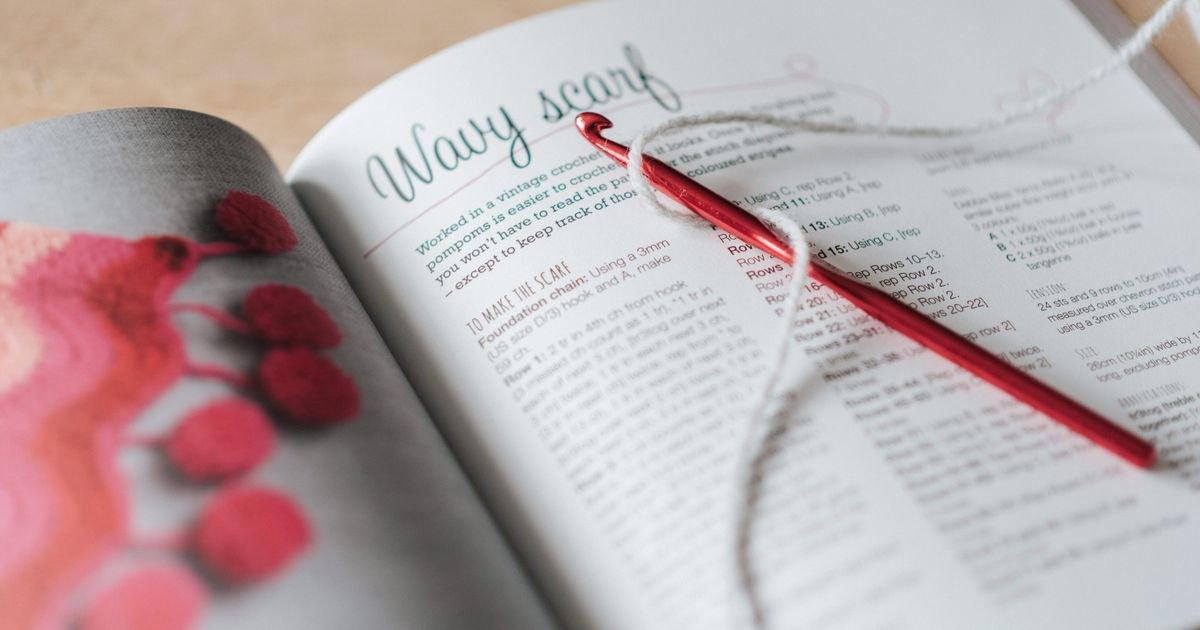
A student once bought a beautiful cardigan pattern from a UK designer, only to realize thirty minutes in that every "dc" she was working was actually a UK double crochet, not the US single crochet she'd been assuming, and her gauge swatch was wildly off as a result. She knew, in principle, that the two systems used the same abbreviations for different stitches. What she didn't have was a reliable way to actually work through an unfamiliar pattern converting as she went, without stopping to second-guess every third row.
That gap, between knowing the two systems exist and actually converting a real, multi-page pattern confidently, is what this guide is for. If you just need the lookup table of which abbreviation matches which stitch, our abbreviations glossary has the full side-by-side reference. This guide is the next step: a practical method for converting an entire pattern before you start, worked examples for the three project types that trip people up differently, garments, granny squares, and amigurumi, and the specific mistakes that cost the most time to unpick.
The upfront-conversion method
Rather than converting as you read, which invites mistakes once you're several rows deep and moving quickly, convert once before you pick up your hook.
- Skim the whole pattern first and list every distinct stitch abbreviation it uses. Most patterns use somewhere between four and eight, even if they're worked over many rows.
- Write your own conversion key next to each one, in the terms you actually crochet in. A sticky note or the margin of a printed pattern works fine; you're not memorizing anything, just having it available at a glance.
- Check your key against the full table in our abbreviations glossary before starting, to catch any mistake in your own key while it's still cheap to fix.
- Work from the pattern using your key, treating every abbreviation as if it were already written in your terms. Don't re-derive the conversion each time you hit the same abbreviation.
This front-loads the mental effort into one careful five-minute pass instead of spreading small, error-prone conversions across an entire project.
Worked example: converting a garment pattern
Garment patterns are usually the highest-stakes place to get a conversion wrong, since a mismatched stitch height changes the finished size, not just the texture.
Say a UK pattern instructs: Row 1: 1tr in each st to end (24 sts). Row 2: 1dc in each st to end. Converted to US terms, that becomes: Row 1: 1dc in each st to end (24 sts). Row 2: 1sc in each st to end. Notice both the treble and the double crochet shift down one "size" in the US system, exactly as the underlying stitch does.
Work your gauge swatch in the converted terms before cutting any garment pieces, since gauge is what determines finished size, and a small conversion slip here is the error most likely to leave a sweater the wrong measurements. Our guide to reading a pattern covers gauge swatching in more depth if that step is new to you.
Worked example: converting a granny square pattern
Granny squares repeat the same short round many times, which is exactly why a conversion mistake here is worth catching early: get round one wrong and you'll repeat that same error across every square in the blanket before you notice.
A typical UK granny round reads: 3ch (counts as 1tr), 2tr in ring, 2ch, [3tr, 2ch] 3 times in ring, join with sl st to top of 3ch. In US terms: 3ch (counts as 1dc), 2dc in ring, 2ch, [3dc, 2ch] 3 times in ring, join with sl st to top of 3ch. Only the stitch name changes; the chain counts, repeat counts, and structure are identical.
Convert and fully work just the first square before starting a full batch, checking it against the pattern's stated finished size. If it matches, the rest of the squares can be worked from the same converted key with confidence. Our granny square tutorial covers the stitch mechanics themselves if you're newer to the technique.
Worked example: converting an amigurumi pattern
Amigurumi carries a specific risk that flat patterns don't: it's worked in continuous spiral rounds with no row-end marker to catch a mistake early, so an error in your conversion can run for many rounds before it becomes visually obvious.
Most amigurumi patterns are written almost entirely in one stitch, single crochet in US terms, or double crochet in UK terms, so the conversion itself is simpler than a mixed-stitch garment. The risk is elsewhere: increase and decrease instructions like inc and dec don't change between systems, since they describe an action rather than a base stitch, and it's easy to assume everything in the pattern needs converting when only the base stitch actually does. Convert just the base stitch, leave increase and decrease abbreviations as written, and double-check your first two rounds' stitch counts against the pattern before continuing. Our amigurumi for beginners guide covers the increase and decrease mechanics if those are new to you.
Why gauge doesn't change with terms
It's worth being explicit about this, since it's a common point of confusion: converting between US and UK terms changes what a stitch is called, not what it measures. A UK treble and a US double crochet are the identical stitch worked the identical way; only the label differs. This means a pattern's stated gauge is exactly as valid after conversion as before it, and you don't need to recalculate anything beyond making sure your own swatch, worked in your terms, matches the number stated.
When a pattern doesn't state its terms at all
Not every pattern, especially older ones, independently published PDFs, or patterns translated from another language, states which terminology system it uses. When that's the case, look for two clues before assuming either way. First, check the designer's country if it's mentioned anywhere in the pattern or on the site it came from, since that's a reasonable starting guess, though far from certain given how much patterns get shared and republished across regions. Second, and more reliably, look at how a dc stitch is described or pictured if there's a photo or diagram: a short, dense stitch described as "dc" means US terms, while a taller stitch under the same abbreviation means UK terms.
If neither clue is available, work the first few rows of your gauge swatch assuming US terms, and compare the resulting fabric height and density to any photo of the finished piece the pattern includes. A clear mismatch, your swatch looking noticeably shorter or taller than the pictured stitches, is a strong sign you guessed the wrong system and should convert before continuing.
Building a reusable cheat card
If you regularly work from both UK and US designers, it's worth making one small reference card, rather than rebuilding your conversion key from scratch on every new pattern. Write the six or seven most common abbreviations in both systems side by side, in the order they appear in the full glossary, and keep it with your project bag or clipped to your pattern binder. Over time you'll likely need it less as the shift becomes second nature, but having it on hand removes the temptation to convert from memory on a pattern where getting it wrong is expensive, like a garment or a large blanket.
Common mistakes & fixes
Fix: skim the whole pattern first, list the handful of abbreviations it actually uses, and convert that short list once. It's faster and far less error-prone than re-converting on every row.
Fix: inc and dec describe an action, not a stitch, and are identical in both systems. Only base stitch abbreviations like sc/dc/tr need converting.
Fix: a converted stitch measures exactly the same as its original; a gauge mismatch after conversion is almost always ordinary tension variation, not a conversion error. See our guide to fixing uneven tension if your swatch consistently comes up the wrong size.
Fix: write the converted round out in full for the first square, verify it against the stated finished size, and reuse that written version for every square after, rather than reconverting from memory each time.
Fix: check your stitch count against the pattern after the first two rounds specifically, since amigurumi's continuous spiral rounds won't naturally flag a conversion mistake the way a row-based pattern would.
Frequently asked questions
What's the fastest way to convert a whole crochet pattern?
Read through the whole pattern once first to spot every stitch abbreviation used, write your own quick conversion key for just those stitches, then work from the pattern as normal, checking your key instead of converting from memory. This is faster and more accurate than converting line by line as you go.
Do stitch counts change when converting between US and UK terms?
No. Only the stitch names change; the number of stitches, rows, and rounds in the pattern stays exactly the same. If your stitch count after conversion doesn't match the pattern's stated count, the error is in the conversion, not in the pattern's numbers.
Is treble crochet the same as double crochet?
Not in the same terminology system. UK treble crochet (tr) is the equivalent of US double crochet (dc); they produce the identical stitch, just under different names depending on which system the pattern uses. Confusing the two within one project results in the wrong stitch height throughout.
Do granny square patterns need different conversion handling than garments?
The stitch conversion itself is identical, but granny squares repeat the same short round many times, so a conversion mistake shows up immediately and repeatedly rather than once. It's worth converting and double-checking just the first round fully before repeating it across the rest of the squares.
Should I convert an amigurumi pattern's terms before or after starting?
Before starting, since amigurumi is worked in continuous spiral rounds without row markers to catch a mistake early. Converting the whole stitch list upfront, and writing your own round-by-round notes in your working terms, is safer than converting on the fly mid-round.
Is there a shortcut for converting half double and half treble crochet?
US half double crochet (hdc) and UK half treble crochet (htr) are the same stitch. They're easy to mix up with the double/treble pair above them, so it helps to remember the pattern: every UK term is exactly one stitch "taller" in name than its US equivalent, across the whole list.
CrochetGuides is a participant in the Amazon Services LLC Associates Program. As an Amazon Associate we earn from qualifying purchases, at no extra cost to you.