Free Crochet Table Runner Pattern for Any Size
A flat double-crochet runner worked back and forth in one easy repeat, sized to your own table and finished with an optional shell border.
A table runner was the project that taught me the difference between fast and satisfying. It looks like a big, ambitious piece, but underneath the size it is really just the same double crochet row you already know, repeated a lot. I remember a student who wanted to dress up her dining table for a family Christmas and was terrified she had bitten off more than she could chew. I told her the only difference between a table runner and a dishcloth is how many times you turn your work, and she had it finished over a couple of evenings in front of the television. That is the honest truth of it. This pattern uses one stitch, one row you repeat, and a border that is completely optional, so it is the kind of big project a beginner can actually finish.
Cotton is the yarn I reach for here, and I have the warped acrylic runner to prove why. The first one I ever made was a soft, pretty acrylic, and after a single wash it looked tired and fuzzy at the edges, the rows gone soft and indistinct. Cotton holds its shape, keeps the stitch definition crisp, and survives being washed every time someone spills gravy on it, which, around a dining table, is a matter of when rather than if. The double crochet means the fabric grows quickly too, which is exactly what you want when you are making something six feet long.
Materials
- Worsted-weight cotton yarn (about 525 yards for a 12in × 72in runner — roughly 85 yards per foot of length)
- 5.0mm (US H/8) crochet hook
- Stitch markers, to keep the first and last stitch of each row straight
- Scissors
- Yarn needle, for weaving in ends
Abbreviations (US terms)
| Abbr. | Means |
|---|---|
| ch | Chain |
| dc | Double crochet |
| sc | Single crochet |
| sl st | Slip stitch |
| sk | Skip |
| st(s) | Stitch(es) |
See our basic crochet stitches guide for a step-by-step on the double crochet, and our yarn weight explained page if the labels are new to you.
Gauge
14 dc and 8 rows measures about 4in / 10cm square with a 5.0mm hook and worsted cotton. Gauge isn't critical for a runner, but it does change the finished width, so check it once before you commit to a size.
Notes
- Written in US terms, worked flat in rows. The turning
ch 3at the start of each row counts as your first double crochet. - Every row should have the same stitch count as your foundation. If it drifts, check the turning chain before it gets away from you.
- Cotton yarn is recommended over acrylic since it washes clean and keeps its crisp stitch definition on a dining table.
- For a quick matching set, the same cotton and hook work up into our coasters pattern or a dishcloth, so you can dress the whole table at once.
Pattern
Ch 44 for the standard 12in width (add or remove chains in fours to change the width).
Dc in 4th ch from hook and in each ch across. The 3 skipped ch count as your first dc. Turn. (42 dc)
Ch 3 (counts as first dc), dc in each st across, working the last dc into the top of the turning ch. Turn. (42 dc)
Repeat Row 2 until the body measures about 1in less than your finished length (2 rows per inch). For a 72in runner, work about 142 rows before the border.
With the RS facing, join yarn at a corner with a sl st, ch 1. Sc evenly around the whole runner, working 3 sc into each corner to turn it. Join with a sl st to the first sc.
Ch 1, sc in next st, sk 1 st, 5 dc in next st, sk 1 st around. Work a shell directly into each corner sc so the scallops turn the corners smoothly. Join, fasten off.
Weave in all ends with a yarn needle, then block the runner flat to settle the edges.
Our pick
Cotton worsted-weight yarn, 3-pack
A smooth worsted cotton that gives the runner crisp stitch definition and washes clean, with enough in a pack to dress the whole table in a matching colour.
View on Amazon →Choosing yarn and colours
For a table runner, cotton is the easy, sensible choice, and I recommend it to almost everyone who sits down with me. It is strong, washable, and keeps its shape, so a runner you make this month still lies flat and looks crisp this time next year. Look for a worsted-weight cotton, which is the same weight most dishcloth and kitchen yarns come in, so it is easy to find and forgiving to work with. A cotton and linen blend gives a slightly softer drape if you want the runner to hang off the ends of the table with a little movement, but it is not essential.
If you are unsure about weights, our yarn weight explained guide walks through what worsted actually means, but the short version is that the label should tell you, and a 5.0mm hook is the happy default. I have also made runners in acrylic when I wanted a specific colour for a party, and they worked, but they never looked as sharp after a wash, and the corners went soft first.
Colour is where a runner gets its personality, and I have two pieces of advice I give to every student. First, a table runner is a background piece, so pick a colour that plays nicely with your plates and tablecloth rather than competing with them. Neutrals, soft greys, sage, and cream all disappear beautifully into a room. Second, if you want a pattern, let the yarn do the talking and keep the stitch plain. A self-striping or gently variegated cotton makes a plain double-crochet runner look far more complicated than the work you actually did, which is my favourite kind of shortcut.
Sizing to your table
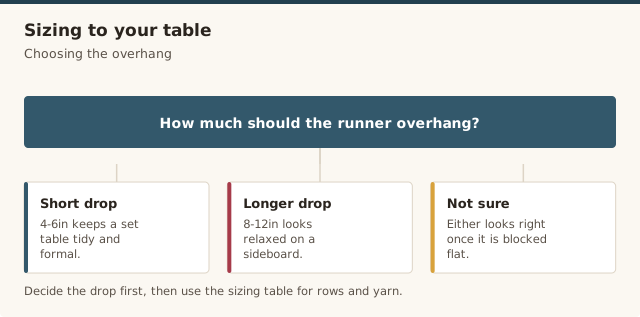
This is the part people get nervous about, and it is genuinely the simplest thing in the pattern. Measure the length of your table, then decide how much you want the runner to hang over each end. The classic choice is a six inch drop on each side, which means your finished runner length is your table length plus twelve inches. A sixty inch table, for example, wants a seventy-two inch runner. Some people prefer a shorter four inch drop, or even a runner that sits entirely on top of the table with no overhang at all, and there is no wrong answer, only a choice.
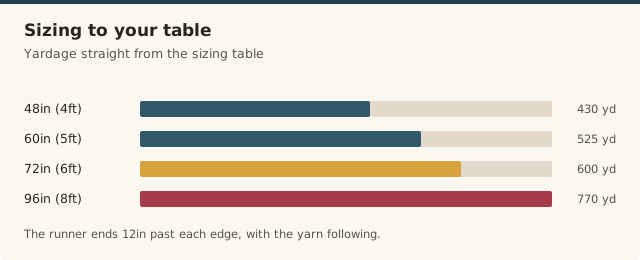
Once you know your target length, the maths is easy because double crochet at this gauge is two rows per inch. Work the body until it is about an inch short of your target, then let the border make up the last inch. The table below gives the common sizes, but you can use it as a starting point rather than a rule.
| Table length | Runner length | Rows (approx.) | Yarn (approx.) |
|---|---|---|---|
| 48in (4ft) | 60in | 118 | 430 yards |
| 60in (5ft) | 72in | 142 | 525 yards |
| 72in (6ft) | 84in | 166 | 600 yards |
| 96in (8ft) | 108in | 214 | 770 yards |
Width works the same way in the other direction. At fourteen double crochet to four inches, each stitch is a little over a quarter of an inch wide, so adding or removing four chains moves the width by about an inch. Most runners sit between twelve and fourteen inches wide, which is what the forty-four chain foundation gives you, but if your table is narrow or you want a wider band down the middle, adjust the foundation chain before you start and keep the same count every row.
Care and blocking
Cotton is the reason a table runner can actually survive the job it was made for. It washes clean, dries flat, and comes back looking like new, which matters when a runner is catching crumbs, water rings, and the occasional dropped fork. I machine-wash my cotton runners on a cool or warm cycle and lay them flat to dry, which stops the long edges from stretching out of shape. Avoid a hot dryer, because even cotton will shrink a little and your carefully measured length will quietly disappear.
Blocking is the step that turns a slightly wobbly rectangle into something that looks professional, and it is worth doing even if you have never blocked anything before. Soak or lightly steam the finished runner, then lay it flat and gently smooth it to the right width and length, pinning the long edges straight so the scallops of the border sit evenly. Our guide to blocking crochet shows the method step by step, and it makes a bigger difference on a long flat piece than it does almost anywhere else.
Because a runner is long, blocking the whole thing at once can be a space problem. If you do not have a surface big enough, block it in sections, working your way along and smoothing each length straight before moving on. The joins between sections flatten out completely once the whole piece has dried.
Seasonal and gifting ideas
A table runner is one of the most giftable things you can make, because it is useful, it is personal, and nobody is going to quibble about the exact shade of a colour they can swap out by season. I have made runners as housewarming gifts in calm neutrals and as Christmas gifts in deep green and cream, and both landed exactly as intended. If you are making one for someone else, a solid colour in cotton is the safest bet, and it pairs beautifully with a matching set of our coasters so the gift feels like a complete table dressing rather than a single piece.
Because the body is plain double crochet, the same pattern swaps seasonally with nothing more than a change of yarn. Spring and summer call for soft pastels or crisp white, autumn for mustard and rust, and winter for deep green, berry, or a classic cream. It is also the rare pattern that scales down neatly into a table mat or a mug rug just by working fewer rows, so once you know the rhythm you can run off a whole coordinating set.
If you finish a runner and want the next step up in a flat, repetitive make, our ripple blanket pattern uses the same row-after-row patience in a bigger shape, and the dishcloth pattern is the perfect two-hour warm-up for getting your tension even before you start something long.
Common mistakes & fixes
Fix: you are accidentally working into the turning chain or adding an extra stitch at the start of each row. Count every row against your starting number, and place a marker in the first and last stitch so the turning chain is never mistaken for a stitch.
Fix: you are skipping the last stitch before turning. Mark the top of the turning chain and make sure your final double crochet of each row goes into it, then count to confirm the count is back where it started.
Fix: your tension is too tight. Loosen your grip as you work the double crochet, and block the finished piece flat. The border also helps, since the weight of the scallops pulls the sides down straight.
Fix: your tension is uneven or you changed hooks partway through. Use the same hook throughout and keep an even rhythm, and recount against your starting number, because a wavy runner is often a sign of extra stitches sneaking in.
Fix: you did not account for the border, or you measured from the chain, which is often tighter than later rows. Measure after a few rows rather than from the foundation, and work until the body is about an inch short of the target so the border finishes the length.
Fix: the single-crochet base round is uneven. Add or remove a single crochet at each corner so the sides sit on a multiple of four, and work a shell directly into the corner stitch so the scallops turn smoothly instead of fighting the corner.
Frequently asked questions
What is the best yarn for a crochet table runner?
Cotton worsted-weight yarn is the best all-round choice, since it is durable, machine-washable, and gives crisp stitch definition. A cotton or linen blend adds drape, while acrylic works too but can pill and look less crisp over time.
What size should a crochet table runner be?
A standard runner is about 12 to 14 inches wide and long enough to hang 6 inches over each end of the table. For a 60 inch table, that means a runner around 72 inches long.
How much yarn do I need for a table runner?
Allow roughly 85 yards of worsted-weight cotton per foot of finished length. A 72 inch runner uses about 525 yards in total, so buy a little more if you plan a deeper border.
How do I size a table runner to my specific table length?
Measure your table, decide how much you want the runner to hang over each end, then add twice that to the table length. Most people choose a 6 inch drop, so runner length equals table length plus 12 inches, and you work two double-crochet rows for every inch.
Can I make a table runner wider or narrower?
Yes, add or remove foundation chains to change the width. At 14 double crochet per 4 inches, each stitch is a little over a quarter inch, so four extra chains widen the runner by about an inch.
How do I stop my table runner from curling at the edges?
Curling usually comes from tight tension, especially if your double crochet is worked very tightly. Loosening your grip slightly and blocking the finished runner flat will settle the edges, and a simple border also helps weigh the sides down.
How do I block a long table runner?
Soak or lightly steam the runner, then lay it flat on a blocking mat or a bed with a towel, smoothing it to the right dimensions and pinning the edges straight. For a long piece, block it in sections if you do not have a surface big enough.
CrochetGuides is a participant in the Amazon Services LLC Associates Program. As an Amazon Associate we earn from qualifying purchases, at no extra cost to you.