Best Crochet Home Decor Patterns for Every Room
From a statement wall hanging to a stack of coasters on the coffee table — ten small ways to bring handmade texture into every room.
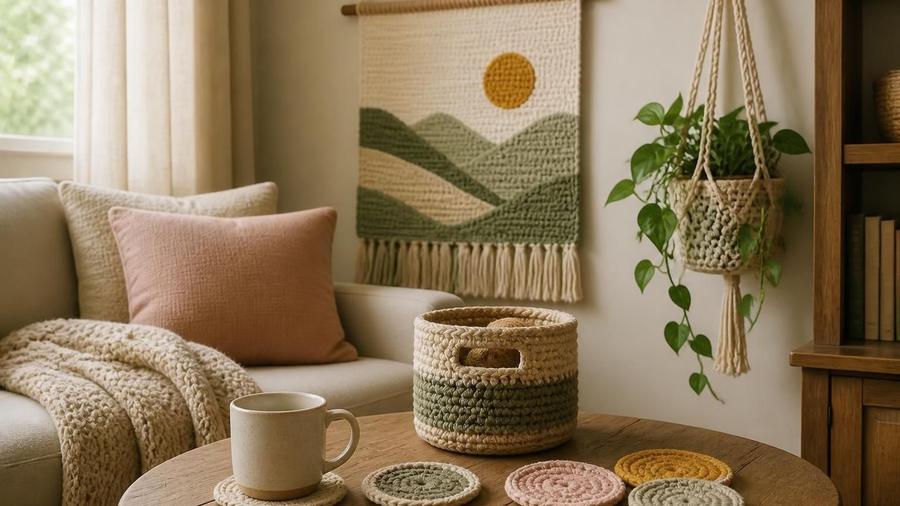
Most of my own home decor crochet started in the kitchen, almost by accident: a dishcloth here, a pot holder there, small useful things that didn't require me to think about matching anything. It took a while before I made the jump to pieces meant to actually be seen, like a wall hanging or a hanging plant holder, and I remember being a little intimidated by the idea that a crochet piece could be the main visual interest in a room rather than something tucked away in a drawer.
This list moves through both kinds of project on purpose, from small kitchen basics you'll use every day to statement pieces that anchor a whole corner of a room. I picked these ten specifically because each one covers a genuinely different room or purpose, so however you're decorating, whether that's a first apartment kitchen or a living room that needs one more textural layer, there's something here that fits.
What I like about home decor crochet specifically, compared to something like a garment, is how low the stakes are. A pot holder or a coaster doesn't need to fit anyone's measurements; if it comes out slightly smaller or larger than planned, it's still perfectly usable. That makes this whole category a good place to practice a new stitch or technique without the pressure of a wearable project, and several of the patterns below are explicitly built that way, borrowing shaping from our amigurumi or hat patterns and applying it to something flat and forgiving instead.
Below, each pattern links straight to its full free instructions, with a short note on where it fits and why it's worth making. For the full collection beyond these ten, our home & décor category has everything currently on the site.
Wall Hanging
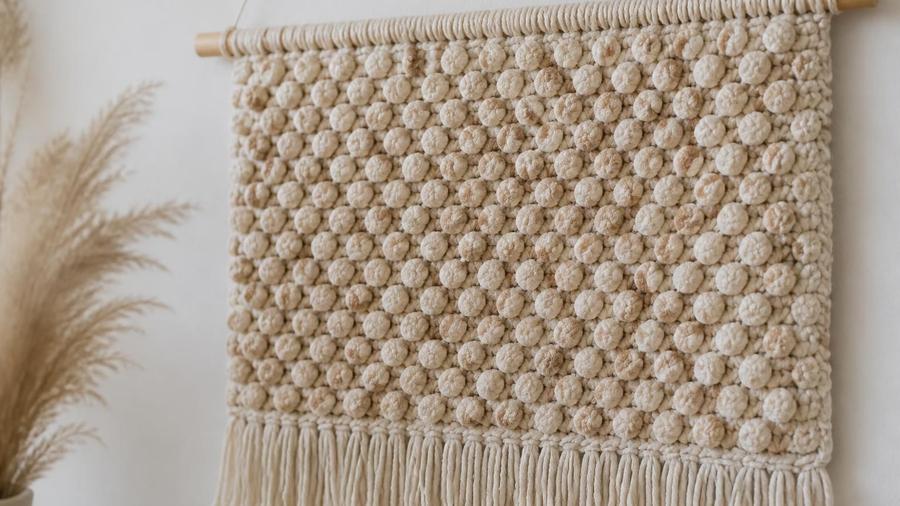
A textured bobble-stitch body suspended from a wooden dowel with a long fringe trim, this is the statement piece on this list, the kind of project that becomes the focal point of whatever wall it hangs on. A good weekend project once you're comfortable with basic texture stitches, and one that scales easily, since a longer dowel and a few extra rows of body simply make a larger, more dramatic piece.
See the full pattern →Table Runner
A flat double-crochet runner worked back and forth in one easy repeat, sized to your own table and finished with an optional shell border. Genuinely simple to resize, since you just work until it reaches your table's length, and a good first project if you want to move beyond small kitchen items into something that dresses up a whole surface.
See the full pattern →Coasters
Quick, round, and endlessly customizable in color, these use the same magic-ring technique from our beanie pattern, just sized down to fit under a mug. One of the fastest projects on this whole list, and a good stash-buster for leftover cotton, since a set of four uses barely any yarn per coaster.
See the full pattern →Pot Holder
A double-thickness square worked specifically for heat safety in the kitchen, in sturdy cotton rather than anything synthetic. A practical, genuinely useful project rather than a purely decorative one, and a good gift alongside a set of dish scrubbies, since the two share the same cotton yarn and make a coordinated kitchen set with very little extra planning.
See the full pattern →Plant Hanger
A simple net-style pouch and hanging cords built from the same flat-circle base as the coasters above, but scaled up and left open to cradle a potted plant. A great way to add height and greenery to a room without needing any extra shelf space, and one of the more satisfying patterns on this list to see finished, since it immediately transforms an ordinary corner.
See the full pattern →Mug Cozy
A flat strip that wraps around a mug and closes with a single button, small enough to finish in one sitting but useful every single morning. A nice pattern to make several of at once, one for every mug in the cupboard, and a genuinely quick way to learn button-loop closures on a low-stakes project before using the same technique somewhere more visible.
See the full pattern →Dish Scrubbies
A small flat circle worked in scrubby yarn, a genuinely useful, reusable alternative to a store-bought sponge that holds up to regular washing. About as quick as the coasters, and a good excuse to try scrubby yarn if you haven't worked with it before.
See the full pattern →Dishcloth
A true beginner pattern using only chain and single crochet, finishing in under an hour with no shaping to learn. If you've never crocheted a single row before, this is the single easiest project on this entire list to start with, and a genuinely useful one to have around once it's done rather than a practice swatch you'll never use again.
See the full pattern →Wine Bottle Cover
A reusable, handmade gift topper built from the same increase-and-decrease shaping used across our amigurumi patterns, just sized for a full bottle instead of a stuffed toy. A nice small project for practicing amigurumi shaping without committing to a whole animal, and one that gets genuine repeat use as a hostess gift or dinner party topper rather than sitting on a shelf once finished.
See the full pattern →Crochet Basket
A flat single-crochet circle that turns a corner and climbs into a sturdy basket, all in one hook with no seaming required. Useful in every room of the house, from bathroom storage to a catch-all by the front door, and a good pattern for understanding how a flat piece turns a corner into a three-dimensional one, a technique that carries over into hats and amigurumi bodies too.
See the full pattern →Picking by room
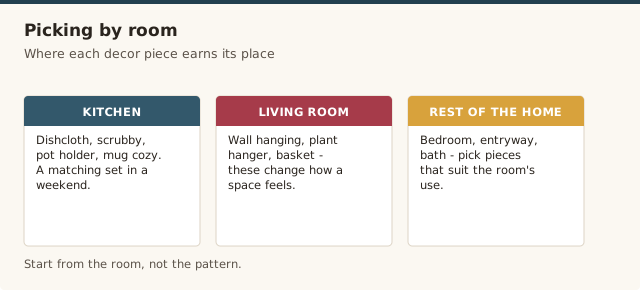
For the kitchen, the dishcloth, dish scrubbies, pot holder, and mug cozy cover almost everything you'd want on a counter or by the sink, and all four are quick enough to make as a matching set in a weekend. For the living room, the wall hanging, plant hanger, and basket are the pieces that actually change how a space feels, since each one adds height, texture, or storage rather than just sitting flat on a surface. The table runner and coasters sit in between, useful anywhere you eat or set things down, whether that's a dining table or a coffee table.
If you're decorating a whole room at once and want everything to feel coordinated, pick one or two yarn colors and repeat them across several projects on this list, for example a basket and a set of coasters in the same shade, rather than treating each piece as a completely separate color decision. A small palette of two or three colors used consistently across a table runner, coasters, and a nearby basket reads as intentional in a way that ten unrelated single-project colors never quite do, even if each individual piece only took an hour or two to make.
Yarn choices for decor vs. kitchen items
The kitchen-facing patterns on this list, dishcloths, scrubbies, pot holders, and mug cozies, should all be worked in 100% cotton, since it's absorbent, machine-washable, and won't melt or scorch the way acrylic can near heat. It's a firmer, slightly less forgiving yarn to work with than acrylic, but it's the right material for anything that's going to touch food, dishes, or a hot pan.
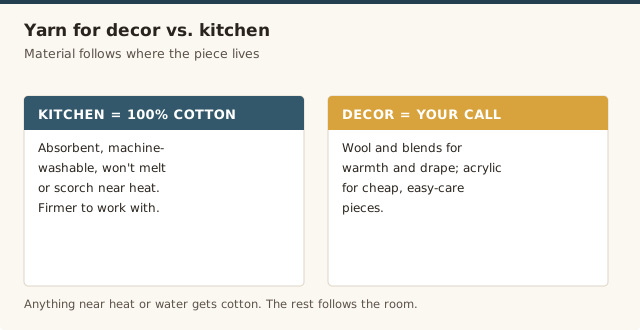
For the purely decorative pieces, the wall hanging, plant hanger, table runner, and basket, you have much more freedom. A cotton or cotton-blend yarn holds its shape well for structured pieces like the basket, while a soft acrylic or wool blend gives the wall hanging's fringe a nicer drape. Our guide to choosing yarn covers fiber trade-offs in more detail if you're not sure which to pick for a specific project.
Frequently asked questions
Which crochet home decor pattern is best for a total beginner?
The dishcloth is the simplest project on this list, using only chain and single crochet with no shaping at all. Coasters and dish scrubbies are close behind, since both are small, flat circles that finish quickly and forgive small stitch-count mistakes.
What room should I decorate first with crochet?
The kitchen is the easiest room to start in, since dishcloths, dish scrubbies, pot holders, and mug cozies are all quick, useful projects that don't require matching an existing color scheme the way a living room piece might.
Which of these patterns makes the best housewarming gift?
The wall hanging and the crochet basket both make strong standalone gifts, since they read as finished decor pieces rather than small kitchen accessories. A set of coasters or dish scrubbies also works well as a smaller, lower-cost gift alongside something else.
What yarn is best for kitchen items like dishcloths and pot holders?
100% cotton is the standard choice for anything that touches food, dishes, or heat, since it's absorbent, machine-washable, and doesn't melt the way acrylic can near a hot pan. Save acrylic and other synthetic blends for purely decorative pieces like a wall hanging or basket.
Can I resize these patterns to fit my own space?
Most of these patterns are written to be adjusted: the table runner is sized to your own table length, the plant hanger's cords can be lengthened or shortened, and the basket and wall hanging both scale up or down with more or fewer rounds or rows. Check each individual pattern's sizing notes before you start.
How long does a typical home decor project take?
Most of the smaller kitchen items, like coasters, dish scrubbies, and dishcloths, finish in well under an hour each. The wall hanging, basket, and table runner are bigger undertakings, typically a few hours spread across one or two sessions.
CrochetGuides is a participant in the Amazon Services LLC Associates Program. As an Amazon Associate we earn from qualifying purchases, at no extra cost to you.